

Understanding Pediatric Dental X-Rays: A Parent's Essential Guide
Pediatric dental X-rays are diagnostic tools that let dentists see beneath your child's gums and inside their teeth—areas impossible to examine with the naked eye. Here's what you need to know:
Key Facts About Pediatric Dental X-Rays:
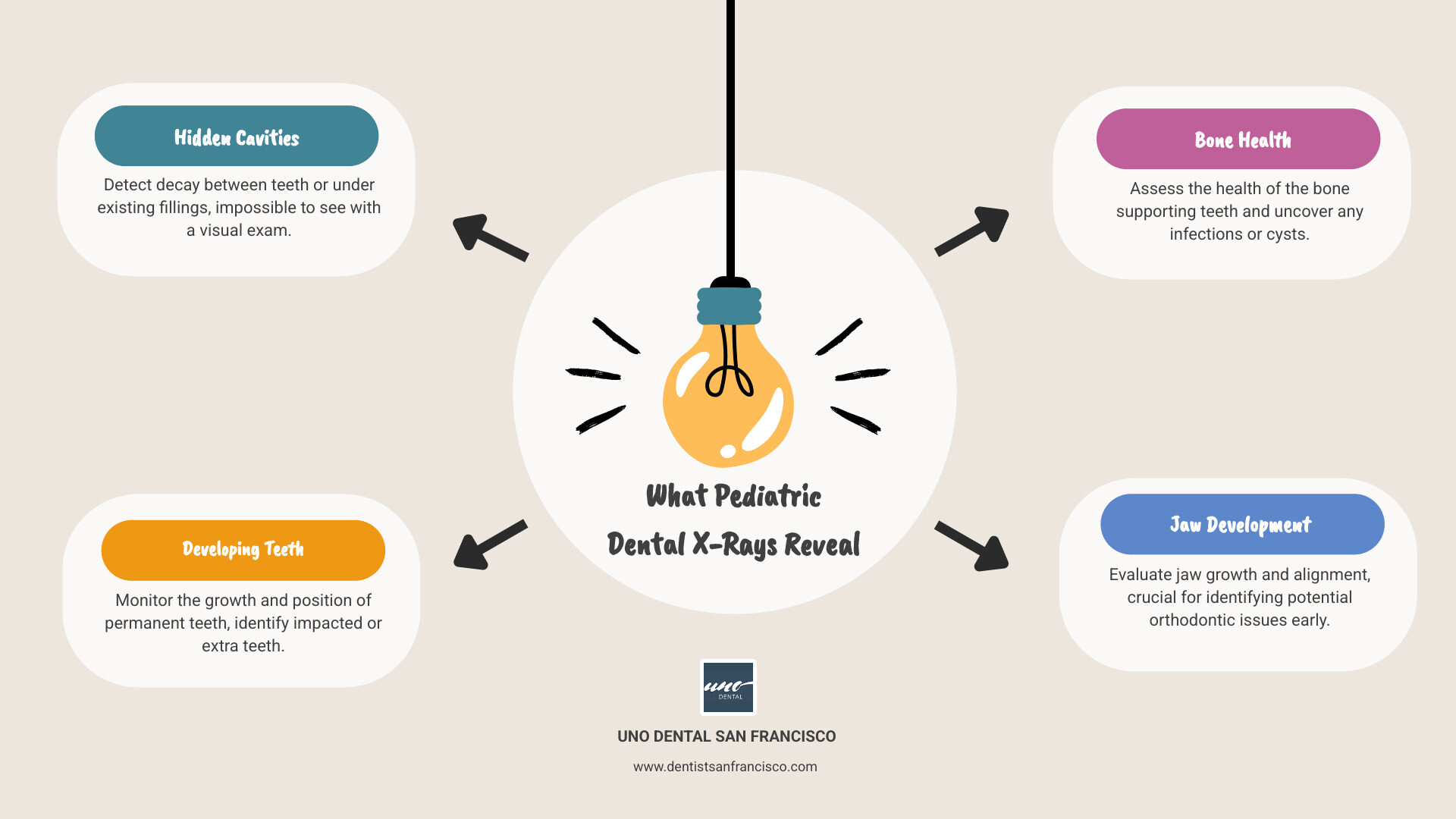
- Purpose: Detect cavities between teeth, monitor permanent tooth development, assess jaw growth, and identify hidden dental problems.
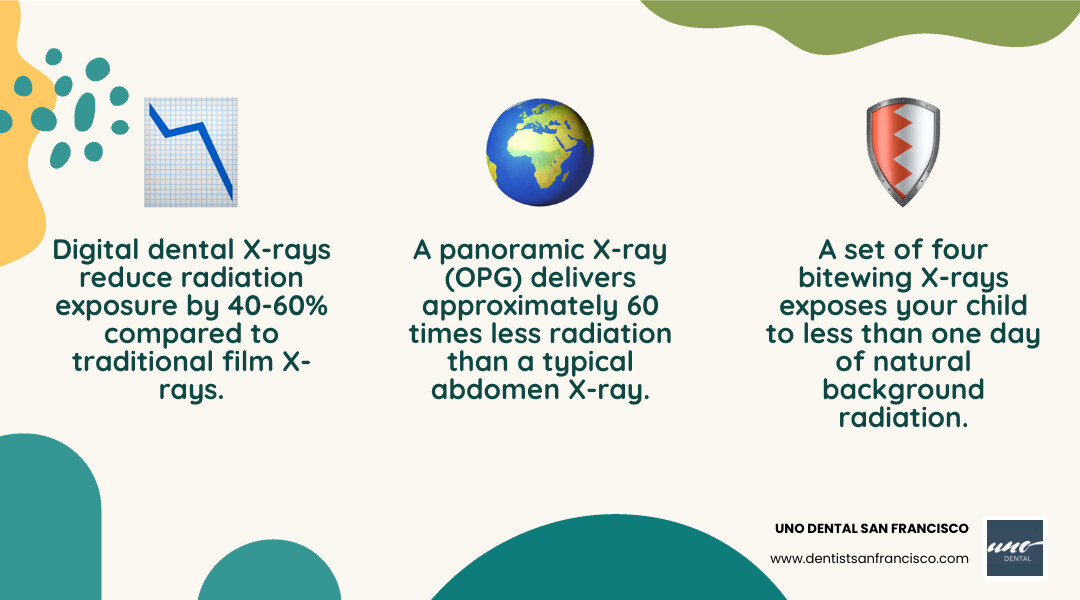
- Safety: Modern digital X-rays use 40-60% less radiation than traditional film, with exposure comparable to a few days of natural background radiation.
- Frequency: Based on individual need, not age—typically once or twice per year for most children, depending on cavity risk and dental development.
- Types: Include bitewings (for cavities), periapicals (for root health), and panoramic views (for overall development).
As a San Francisco parent, understanding your child's dental care is a top priority. While any radiation exposure can seem concerning, modern dental X-rays are one of the most valuable and safe tools for protecting your child's oral health.
Unlike a visual exam, X-rays reveal hidden issues like decay between teeth, problems with developing permanent teeth, and jaw growth irregularities before they become painful or costly. The radiation from a full set of dental X-rays is less than what your child gets from natural background radiation in just a few days.
At UNO DENTAL SAN FRANCISCO, Dr. Mohammad Aghiad Kandar has over 15 years of experience guiding families in their children's dental care. His UCSF training and commitment to the latest digital imaging technology ensure your child receives the safest, most accurate diagnostic care available.
Why X-Rays are a Vital Part of Your Child's Dental Checkup
We understand that X-rays for your child can raise questions. However, after years of caring for San Francisco families, we know that pediatric dental X-rays are one of the most powerful tools for protecting your child's smile.
A visual check of your child's teeth only tells half the story. Problems often start between teeth, under the gums, or within the jawbone, growing quietly until they cause pain or require extensive treatment.
Early detection is key. A tiny cavity found on an X-ray means a simple filling. Left undetected, it could become a painful infection requiring more invasive treatment and causing more anxiety for your child.
While a visual exam spots obvious issues, it has limits. We can't see through tooth structure or below the gum line with our eyes alone. This is where pediatric dental X-rays become invaluable. They show us how permanent teeth are developing, help us assess jaw development to catch bite issues early, and identify impacted or extra teeth.
After an injury, an X-ray can reveal hidden fractures in the tooth root or damage to developing permanent teeth. This allows for immediate, proper treatment to prevent future complications. X-rays also help diagnose rare but serious pathologies like cysts or infections that show no external symptoms. Early detection is critical.
For more information on caring for those precious baby teeth, visit our page on Baby Teeth Care.
What X-Rays Can Uncover
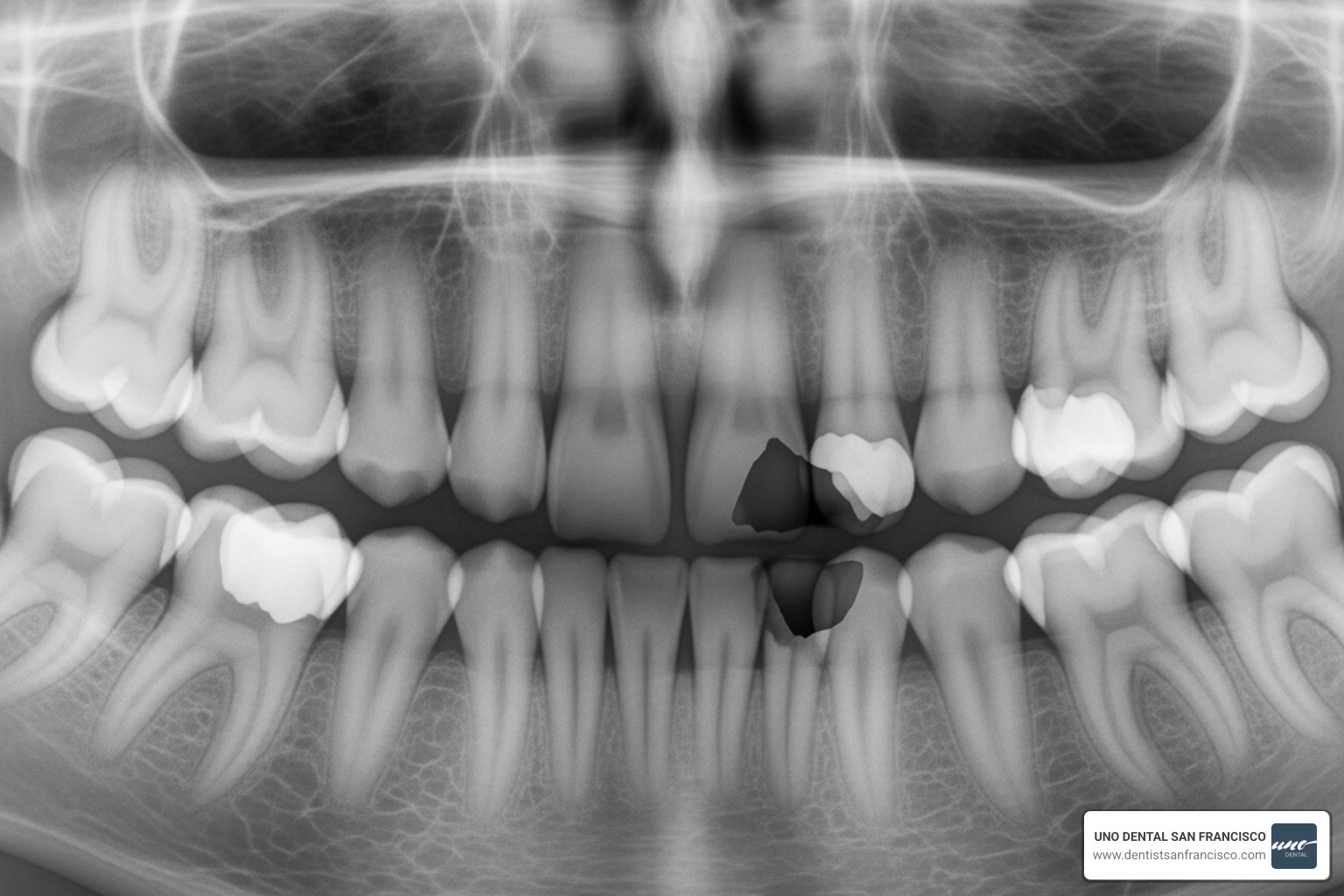
The hidden problems that only pediatric dental X-rays can reveal include:
- Interproximal cavities (between teeth): These are invisible during a visual exam until they become large.
- Abscesses or infections: Root and bone infections often show no external signs until they are severely painful.
- Bone loss: An early indicator of gum disease or other conditions.
- Developmental abnormalities: Cysts, tumors, or unusual growths in the jawbone.
- Problems with unerupted teeth: Permanent teeth that are impacted (stuck), growing in the wrong direction, or missing.
- Root positions for orthodontic planning: Essential information to guide effective orthodontic treatment.
By revealing what's happening beneath the surface, X-rays empower us to provide truly comprehensive care, intervene early, and keep treatments simple.
A Parent's Guide to Pediatric Dental X-Rays: Types and Purposes
During your child's visit, we may recommend different types of X-rays. We select specific pediatric dental X-rays based on what we need to see, much like a photographer chooses different lenses. At UNO DENTAL SAN FRANCISCO, our high-tech imaging provides clear diagnostic information with minimal radiation exposure. Understanding these X-rays can help you feel more confident in your child's care.
The two main categories are intraoral X-rays (sensor inside the mouth) and extraoral X-rays (imaging equipment outside the mouth). Each has a unique purpose.
Common Intraoral X-rays
Intraoral X-rays provide detailed, close-up views of individual teeth and surrounding bone.
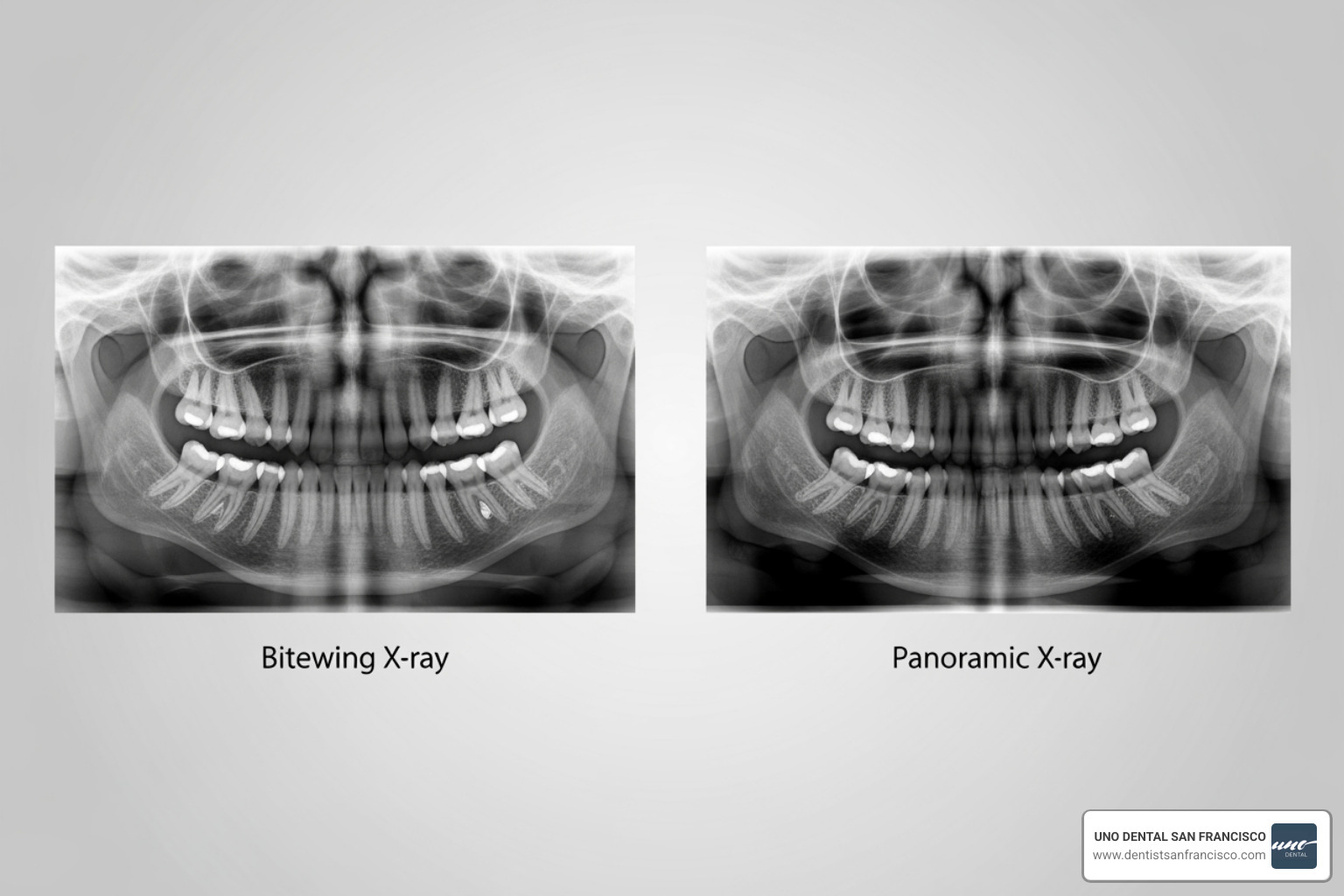
Bitewing X-rays are common and show the crowns of the upper and lower back teeth. Your child bites on a small tab to hold the sensor. We use bitewings mainly for cavity detection between teeth, which is invisible to the naked eye. Depending on cavity risk, most children need bitewings once or twice a year.
Periapical X-rays show an entire tooth, from crown to root tip and the surrounding bone. We use them to investigate specific tooth concerns, diagnose root infections, check developing permanent teeth, and assess trauma.
Occlusal X-rays show a full upper or lower arch of teeth. Your child bites on a larger sensor. These are useful for tracking tooth development in younger children, finding hidden extra teeth, and checking the placement of erupting teeth.
Common Extraoral X-rays
Extraoral X-rays provide a wide-angle view of the teeth, jaws, and facial structures.
Panoramic X-rays offer a complete overview of all teeth, both jaws, and surrounding bones in a single image. The machine rotates around your child's head, so no sensor goes inside the mouth. This full mouth view is invaluable for spotting impacted teeth (including wisdom teeth), identifying extra or missing teeth, and evaluating overall jaw development.
Cephalometric X-rays provide a side profile view of the head, showing the relationship between the teeth, jaws, and skull. They are used primarily for orthodontic planning. This view helps us analyze growth patterns and jaw alignment to plan the most effective treatment, like braces.
For more details on our comprehensive approach to caring for your child's smile, visit our Kids Dentistry page.
Are Dental X-Rays Safe? Understanding Radiation and Modern Technology
It's natural for parents to have concerns about radiation. At UNO DENTAL SAN FRANCISCO, we take radiation safety seriously, using the strictest protocols and most advanced technology.
Modern pediatric dental X-rays use extremely low radiation levels, where the benefits of early detection far outweigh the minimal risks. We use digital radiography exclusively, ensuring your child is exposed to the lowest possible radiation dose.
For perspective, a set of four bitewing X-rays has less radiation than one day of natural background radiation. A panoramic X-ray is about 0.007 mSv, far less than other medical X-rays. Dental imaging is a tiny fraction of the average person's annual radiation exposure from all sources.
We strictly follow the ALARA principle (As Low As Reasonably Achievable). This means we only take X-rays when necessary, use the lowest possible dose for clear images, and stay well below safety limits. We adhere to all guidelines from the American Dental Association and FDA. For more details, you can review the FDA's guidance on children's X-rays.
Here's a helpful comparison showing just how minimal dental X-ray radiation really is:
Ensuring Safety During Pediatric Dental X-rays
We take multiple steps to protect your child during pediatric dental X-rays, ensuring both safety and comfort.
- Protective Gear: We use protective lead aprons to shield your child's torso and offer thyroid collars for extra protection and parental peace of mind.
- Advanced Technology: Our sensitive fast digital image sensors capture clear images with minimal radiation and allow for immediate review, reducing the need for retakes.
- Precision: Our experienced team uses precise positioning to get it right the first time, minimizing your child's time in the chair.
- Child-Friendly Approach: We use the "Tell-Show-Do method"—we explain the process, show them the equipment, and then perform the quick procedure. This builds trust and makes the experience smoother.
Our team is trained to work patiently with children, and we encourage parents to be present for support. The entire process is quick and easy.
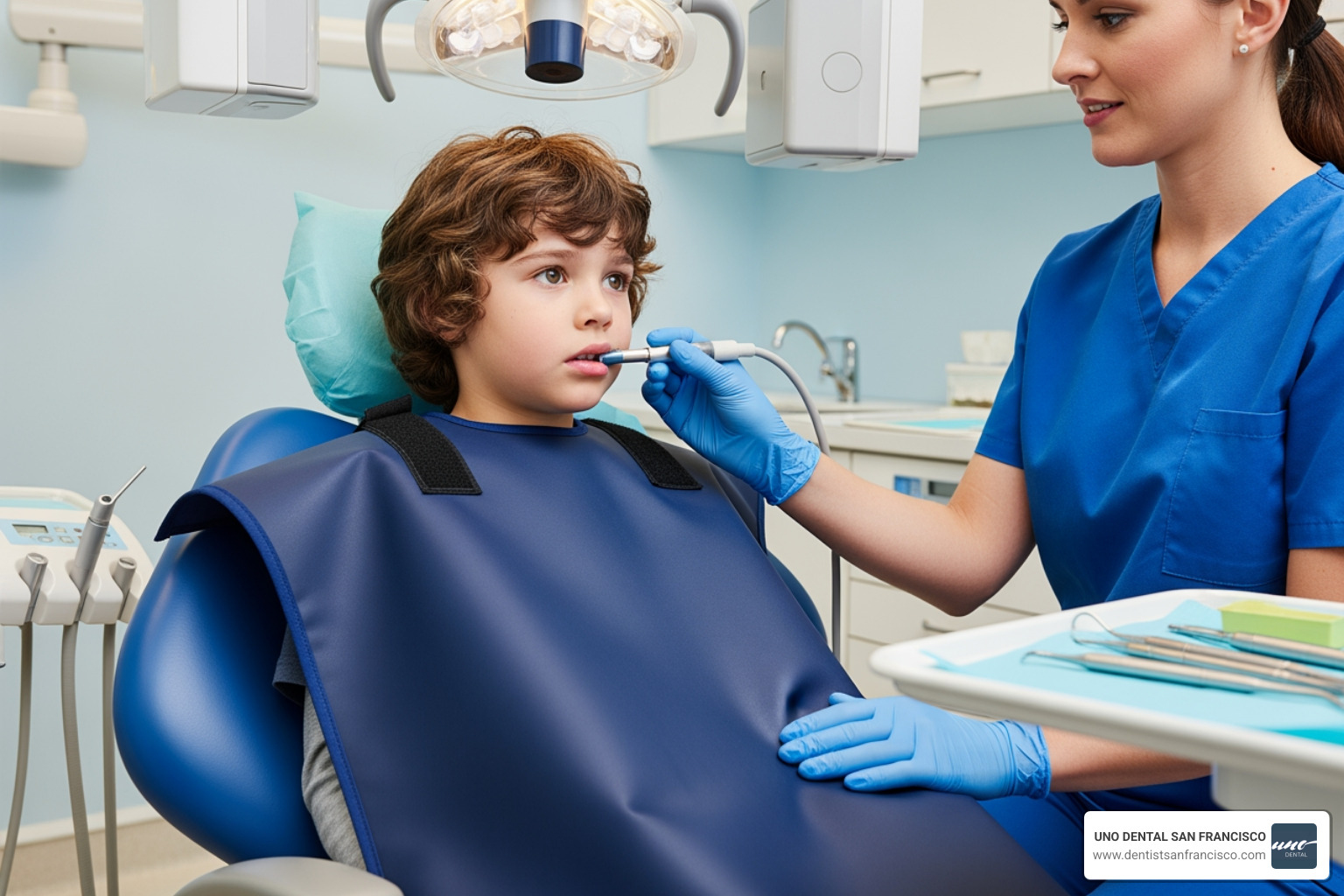
By combining state-of-the-art technology with compassionate care, we ensure your child's X-ray experience is safe, comfortable, and positive.
X-Ray Frequency and Orthodontic Planning
Parents often ask how often their child needs pediatric dental X-rays. There's no universal answer, as every child's needs are unique. At UNO DENTAL SAN FRANCISCO, we take an individualized approach. Our recommendations are based on a comprehensive evaluation of your child's specific oral health, clinical exam, dental history, and risk factors.
Risk-Based Scheduling: What Determines Frequency
The frequency of X-rays depends on your child's risk for cavities (caries risk).
- Low Caries Risk: For children with good oral hygiene and no history of dental issues, we may recommend X-rays every 12 to 24 months to monitor development.
- High Caries Risk: For children with a history of cavities, crowded teeth, or orthodontic appliances, we may recommend X-rays every 6 to 12 months to stay ahead of potential problems.
We follow the latest clinical practice guidance from the American Academy of Pediatric Dentistry (AAPD) and ADA, ensuring X-rays are only taken when diagnostically necessary.
Planning for Your Child's Best Smile: The Orthodontic Connection
Pediatric dental X-rays are especially important for orthodontic planning. They provide an invaluable window into your child's developing jaw and emerging permanent teeth.
During the critical years between ages 10 and 14, panoramic and cephalometric X-rays are crucial. These images allow us to:
- Monitor growth and development patterns and track permanent teeth.
- Identify impacted teeth (like canines or wisdom teeth) long before they cause problems.
- Analyze jaw and bite relationships to spot issues that may benefit from early intervention.
- Plan for braces by revealing the precise position of tooth roots, which is critical for moving teeth safely and effectively.
By tailoring X-ray frequency to your child's needs and using these images for orthodontic planning, we help ensure their dental journey is as smooth as possible. For more information about our comprehensive approach to growing smiles, visit our Children's Dental services page.
Frequently Asked Questions about Pediatric Dental X-rays
We believe informed parents are confident parents. Here are answers to some of the most common questions we hear about pediatric dental X-rays.
At what age will my child need their first dental X-ray?
There is no specific age for a child's first dental X-ray. The decision is based on individual need, an approach supported by the American Academy of Pediatric Dentistry. We recommend X-rays when a visual exam isn't enough, such as in cases of:
- Crowded teeth where cavities can hide
- Dental trauma that requires root assessment
- High risk for cavities
- Monitoring the growth of permanent teeth
A child's first X-ray could be around age five or six, or later, depending on these factors. We only take X-rays when they are diagnostically essential.
How do you help an anxious child cooperate for an X-ray?
Our experienced team at UNO DENTAL SAN FRANCISCO uses a gentle, patient-centered approach to help anxious children feel confident. We use the "Tell-Show-Do" technique, explaining and demonstrating the process before we begin. Our fast digital X-ray system also helps by capturing images almost instantly, minimizing discomfort.
We use positive reinforcement and encourage parents to stay in the room for comfort. For children with significant anxiety, we offer safe and effective options for Dental Sedation for Children to ensure they can receive necessary care without stress.
Are dental X-rays for children covered by insurance?
Usually, yes. Most dental insurance plans cover pediatric dental X-rays as a vital diagnostic and preventative tool. However, specifics vary by plan. Coverage for routine bitewings may differ from panoramic X-rays for orthodontics, and your plan's deductibles, co-pays, and annual maximums will affect out-of-pocket costs.
At UNO DENTAL SAN FRANCISCO, we prioritize transparent pricing. Our team will help you understand your insurance benefits and can request a pre-authorization from your provider to clarify costs upfront. We are committed to making quality dental care accessible and affordable.
A Clear Path to Your Child's Lifelong Oral Health
As a parent, understanding the tools that protect your child's smile is empowering. Pediatric dental X-rays blend technology and compassionate care, revealing hidden issues before they become big problems. They are safe, informative, and essential for detecting cavities, monitoring tooth development, and planning for orthodontics.
At UNO DENTAL SAN FRANCISCO, we provide personalized care custom to your child's unique needs and risk factors. From bitewings to panoramic images, our goal is to give your child the healthiest start for a lifetime of confident smiles. We take the time to explain every tool and answer your questions. Our high-tech digital imaging provides clear pictures with minimal radiation, reflecting our holistic approach to your child's overall health.
Your child deserves a dental home where advanced technology meets genuine warmth, where safety is paramount, and where every visit builds trust. We invite you to experience what comprehensive, individualized pediatric dental care looks like. Schedule a visit with a top Pediatric Dentist in San Francisco and let us partner with you in creating a future filled with healthy, beautiful smiles. Together, we'll give your child the foundation for lifelong oral health.
Reviewed by Dr. Mohammad Aghiad Kandar.