
Decoding Your Dental Coverage Options
Choosing between a dental savings plan vs. insurance impacts both your wallet and your oral health. Navigating dental coverage can be overwhelming, with confusing terminology and unclear costs.
Here's the essential difference you need to know:
| Dental Savings Plan | Traditional Dental Insurance |
|---|---|
| Membership program with annual fee | Monthly premiums plus deductibles |
| Offers discounts (10-60% off) | Pays a percentage of costs |
| Immediate use, no waiting periods | Waiting periods for major work (3-12 months) |
| No annual coverage limits | Annual maximums ($1,000-$2,000) |
| No paperwork or claims | Requires filing claims |
| Best for: Uninsured, extensive/cosmetic work | Best for: Employer coverage, routine care |
According to industry data, dental care costs in the U.S. average $360-$700 annually for preventive visits alone. For many San Francisco professionals, insurance premiums ($20-$50/month) and out-of-pocket costs can exceed their yearly dental spending.
The challenge is understanding what you get for your money. Insurance may cover preventive care at 100%, but for a crown or implant, you could pay 50-75% of the bill after meeting a deductible and enduring a waiting period.
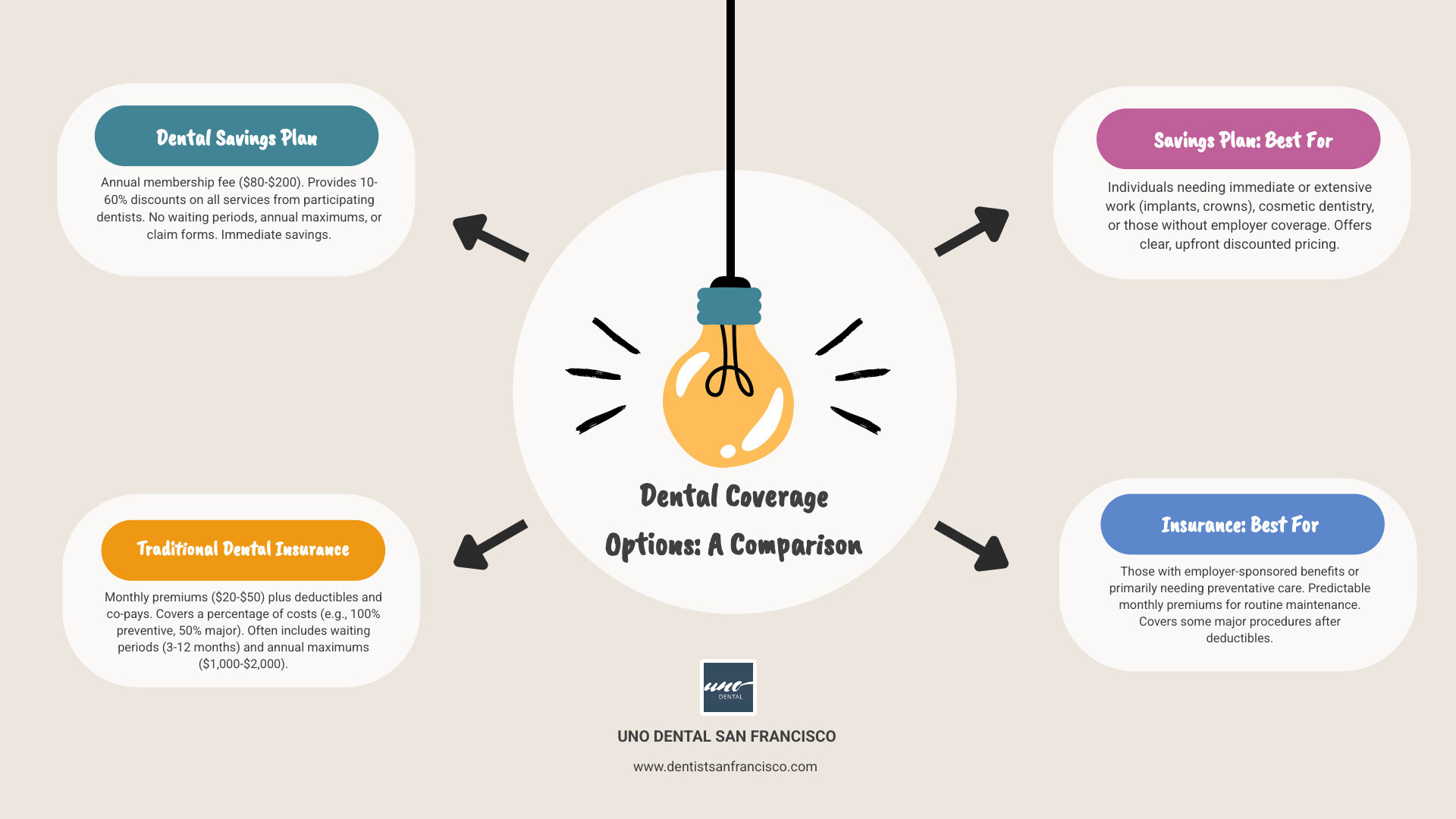
Dental savings plans are different. They aren't insurance. You pay an annual fee (typically $80-$200) for immediate discounts on all services from participating dentists. There are no claims, waiting periods, or annual maximums.
I'm Dr. Mohammad Aghiad Kandar of UNO DENTAL SAN FRANCISCO. With 15 years in dentistry, I've helped countless patients steer the dental savings plan vs. insurance decision. My experience has shown that the best choice depends on your individual needs, expected dental work, and budget.
What is a Dental Savings Plan?
A dental savings plan is a simple, direct way to make dental care affordable. It's a membership program—not insurance—designed to help you save on a wide range of dental services.
You pay a small annual fee, typically $80 to $200 for individuals or around $150 for families. As a member, you gain access to a network of participating dentists, like us at UNO DENTAL SAN FRANCISCO, who have agreed to offer services at special, discounted rates.
The approach is straightforward. Unlike insurance, where a company pays a portion of your bill, you simply pay the discounted rate directly to your dentist at the time of service.
Patients love savings plans for their simplicity and lack of common insurance hassles. Key benefits include:
- No waiting periods: Start saving on treatments almost immediately. This is a huge relief for urgent care needs.
- No annual limits: There’s no cap on how much you can save. You receive discounts on every service, no matter how extensive the work.
- No deductibles: Your discounts are available from day one without having to meet a spending threshold.
- No claim forms: You pay the discounted rate directly, so there's no paperwork or reimbursement process.
These plans can offer significant discounts, often 10% to 60% off typical dental work, including routine check-ups, complex procedures, and even cosmetic treatments.
At UNO DENTAL SAN FRANCISCO, we offer our own patient-centered Dental Savings Plan. It's designed to give our San Francisco community predictable costs and substantial savings, reflecting our commitment to helping you achieve a healthy smile without breaking the bank.
How Does Traditional Dental Insurance Work?
Dental insurance functions much like health insurance but is focused on your oral health. It's designed to manage dental care costs through regular payments in exchange for coverage.
First, you pay a monthly premium to keep your plan active, typically ranging from $20 to $50 for an individual.
Before your insurance contributes to most services, you must meet a deductible, which is an out-of-pocket amount you pay each year (often around $50). Once met, your insurance helps share the cost. Investopedia offers a clear explanation of Co-pay vs. Deductible.
You may also have a co-payment (co-pay), a fixed amount you pay for a service, or coinsurance, the percentage of the cost you're responsible for after meeting your deductible.
Many dental insurance plans use a "100-80-50" coverage structure:
- Preventative Care: Routine check-ups, cleanings, and X-rays are often covered at 100%, usually without needing to meet your deductible.
- Basic Services: Fillings, simple extractions, and root canals typically receive around 80% coverage after your deductible.
- Major Procedures: Crowns, bridges, and dentures are generally covered at about 50% after your deductible.
Be aware of two common limitations:
Annual maximums are the highest amount your insurer will pay in a year, typically $1,000 to $2,000. Once you hit this limit, you are responsible for all further costs.
Waiting periods may require you to be enrolled for a set time (e.g., 3-12 months) before certain basic or major procedures are covered.
Finally, insurance plans operate within provider networks:
- Preferred Provider Organization (PPO): These plans offer a network of dentists with discounted rates. You can see out-of-network dentists, but your costs will be higher. At UNO DENTAL SAN FRANCISCO, we are in-network for several major PPO plans and work with many others as an out-of-network provider.
- Dental Health Maintenance Organization (DHMO): These plans often have lower premiums but require you to use a primary dentist within their network for coverage. We do not accept HMO plans.
Understanding these details is key when weighing your options. We provide more information on our Dental Insurance & Financing options page.
Head-to-Head Comparison: Dental Savings Plan vs Insurance
Making the choice between dental savings plan vs insurance becomes much clearer when you see them side-by-side. Each option has distinct advantages depending on your situation.
| Feature | Dental Savings Plan | Traditional Dental Insurance |
|---|---|---|
| Cost Structure | Annual membership fee (e.g., $80-$200/year) | Monthly premiums (e.g., $20-$50/month) + deductibles + co-pays/coinsurance |
| Waiting Period | None; immediate savings | Often 3-12 months for basic/major procedures |
| Annual Limit | None; discounts apply to all services | Typically $1,000-$2,000 maximum per year |
| Paperwork | None; pay discounted rate directly | Claims forms often required for reimbursement |
| Cosmetic Coverage | Discounts usually apply to cosmetic procedures | Rarely covers elective cosmetic procedures |
| Provider Network | Specific network of participating dentists | PPO (in-network & out-of-network options), DHMO (in-network only) |
| Payment Method | You pay the dentist the discounted fee | Insurance pays a portion; you pay deductible, co-pay, coinsurance |
Cost Breakdown: Dental Savings Plan vs Insurance
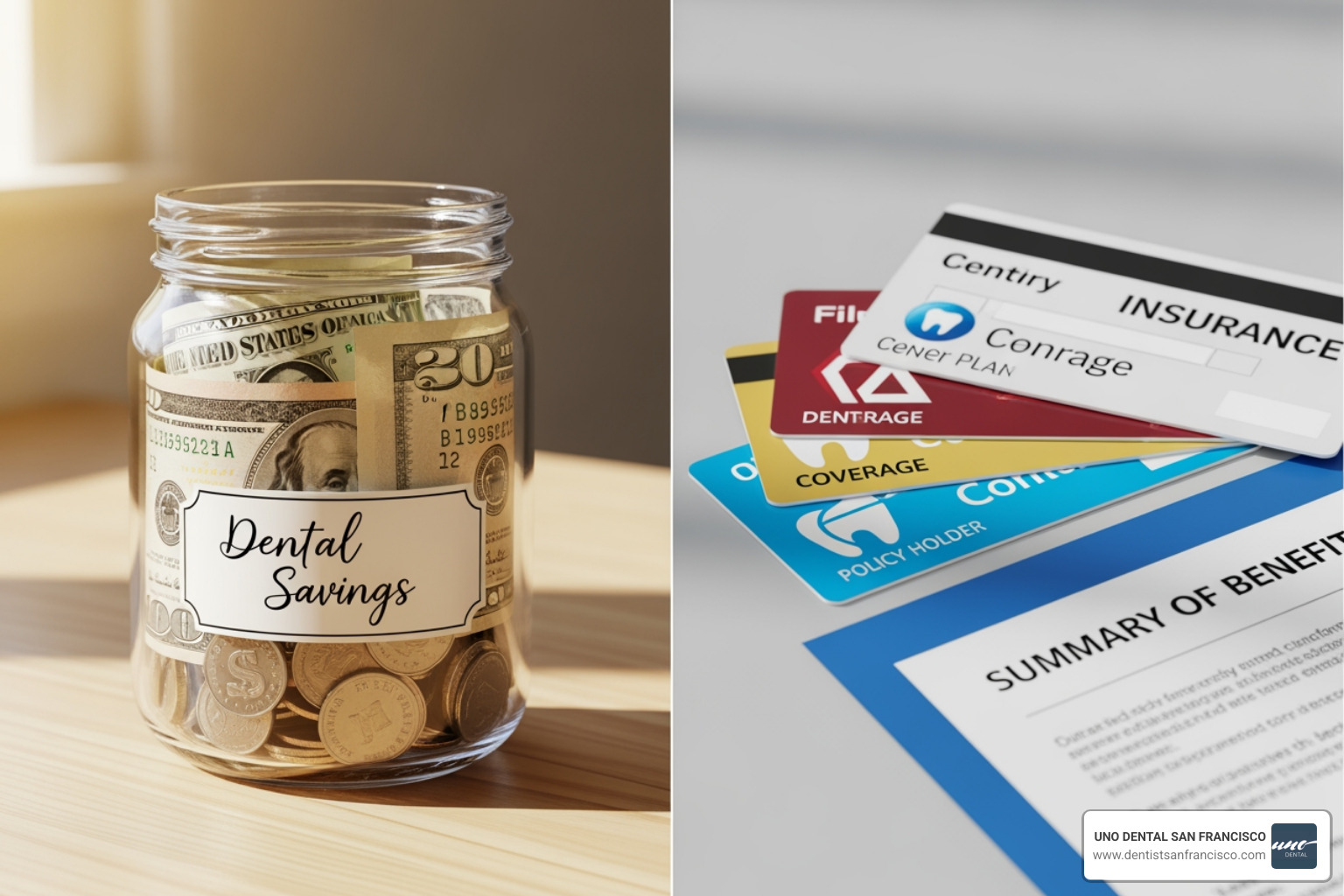
The financial structures of these two options are completely different.
A dental savings plan involves a straightforward annual membership fee ($80 to $200 for an individual). After paying the fee, you receive discounts of 10% to 60% on all services, paying the reduced amount directly to the dentist. There are no surprise deductibles or co-pays.
Traditional dental insurance has multiple costs. You pay monthly premiums ($20 to $50/month, or $240 to $600 annually), a deductible (often around $50), and co-pays or coinsurance for most services. For a deeper look at these expenses, see How Much Does Dental Insurance Cost?. With insurance, you pay monthly regardless of use, plus additional costs when you need care.
Coverage for Procedures: From Cleanings to Crowns
How each option handles different types of work reveals significant differences.
For preventative care (cleanings, exams), insurance often covers 100%, while savings plans offer substantial discounts, making them very affordable.
For basic restorative work (fillings), insurance usually covers about 80% after your deductible. Savings plans provide a percentage discount on the entire fee.
Major procedures like crowns, bridges, and implants are where the decision is critical. Insurance typically covers only 50% of these expensive treatments, and costs can quickly exhaust your annual maximum. Savings plans offer discounts on the entire cost with no annual limits. If you need multiple major procedures, the savings can be substantial. Our Affordable Dental Implants Complete Guide details these considerations.
Cosmetic dentistry is where savings plans truly shine. Traditional insurance rarely covers elective procedures like teeth whitening or veneers. Most dental savings plans, however, do offer discounts on these services. Exploring Dental Plans for Cosmetic Dentistry can reveal significant savings.
Waiting Periods and Annual Limits
These two features dramatically affect your access to care and final cost.
Waiting periods are a frustrating aspect of insurance. You might pay premiums for months before coverage for basic or major work begins. Dental savings plans have no waiting periods, allowing you to use your discounts almost immediately.
Annual limits are another key difference. Insurance caps benefits at $1,000 to $2,000 per year. Once you reach that limit, you pay 100% of further costs. Dental savings plans have no annual maximums, so your discounts apply no matter how much work you need.
Pros and Cons: Which Plan is Right for You?
Choosing the right dental coverage is about aligning a plan with your unique individual needs, your budget, and the kind of dental work you anticipate needing. Let’s weigh the pros and cons of each option so you can make an informed decision for your smile.

The Case for Dental Savings Plans
Dental savings plans offer a flexible and straightforward alternative to insurance.
Pros:
- Lower upfront cost (annual fee vs. monthly premiums).
- No waiting periods for any procedure.
- No annual limits on how much you can save.
- Discounts often apply to cosmetic and major procedures.
- Simple to use: no deductibles, co-pays, or claim forms.
Cons:
- You must use dentists within the plan's network.
- You pay the full discounted bill at the time of service.
Best for: Uninsured individuals, those needing immediate or extensive work, patients seeking cosmetic dentistry, and self-employed individuals or retirees.
The Case for Dental Insurance
Traditional dental insurance is a common choice, especially as an employer benefit.
Pros:
- Low or no cost for preventative care (cleanings, exams).
- Predictable monthly payments for budgeting.
- Very cost-effective if heavily subsidized by an employer.
Cons:
- Waiting periods for basic and major work.
- Annual coverage caps (typically $1,000-$2,000).
- Additional costs from deductibles and co-pays.
- Paperwork and claims can be a hassle.
- Limited or no coverage for cosmetic procedures.
Best for: Those with strong employer-sponsored coverage, individuals who primarily need preventative care, and families who prefer a fixed monthly premium structure.
Frequently Asked Questions about Dental Coverage
We know the dental savings plan vs insurance decision brings up lots of questions. Let's tackle the most common ones with clear, straightforward answers.
Can I have both a dental savings plan and dental insurance?
Yes, and it can be a smart strategy. You can use your dental savings plan after you've hit your insurance's annual maximum. This allows you to continue receiving discounts on any additional care you need for the rest of the year.
This combination is also valuable for procedures insurance doesn't cover, like cosmetic dentistry. Your savings plan can provide discounts on teeth whitening or veneers that insurance won't touch. You generally can't use both on the same procedure, but you can often use the savings plan to reduce your remaining out-of-pocket costs after insurance has paid its portion. Our team can help you coordinate benefits to maximize your savings.
What if neither a dental savings plan nor insurance is ideal?
If neither option feels right, you have alternatives. At UNO DENTAL SAN FRANCISCO, we are committed to making care accessible.
We offer flexible in-house payment plans that break down treatment costs into manageable monthly installments. You can learn more on our Dental Payment Plan Options page.
Third-party financing is another popular choice, often providing low or no-interest promotional periods.
If you have a Health Savings Account (HSA) or Flexible Spending Account (FSA), you can use these pre-tax dollars to pay for dental expenses, effectively giving you a discount. These accounts can be used with or without a dental plan.
Our philosophy is that finances shouldn't be a barrier to care. We are dedicated to Making Dental Care Affordable for everyone in San Francisco.
How are cosmetic procedures like veneers or Invisalign handled?
This is where the dental savings plan vs insurance comparison becomes crystal clear. Cosmetic procedures are considered elective and are designed to improve your smile's appearance.
Traditional dental insurance almost never covers cosmetic treatments. If a procedure is both restorative and cosmetic, insurance might cover a portion, but any aesthetic upgrade is usually your full responsibility.
Dental savings plans, however, typically offer significant discounts on cosmetic procedures like veneers and Invisalign. Our Dental Plans for Veneers Guide and Clear Aligner Payment Plan pages explain how a savings plan can make these treatments much more affordable.
We offer free virtual smile consultations to discuss your goals and financing options to help you achieve your dream smile.
Making the Right Choice for Your Smile in San Francisco
By now, you have a clearer picture of the differences between a dental savings plan vs. insurance. Savings plans offer immediate discounts with no annual limits or waiting periods, while traditional insurance provides percentage-based coverage but comes with premiums, deductibles, and caps.
There is no single "best" answer. The ideal choice depends on your personal dental needs, budget, and expected treatment. If you have good employer coverage and mainly need routine care, insurance may be a great fit. If you're uninsured, need extensive work, or want cosmetic procedures, a dental savings plan could offer the flexibility and savings you need.
At UNO DENTAL SAN FRANCISCO, we are committed to patient-centered, affordable care. Our high-tech and holistic approach means we care for your overall well-being, not just your teeth. We believe financial concerns shouldn't stand in the way of your oral health.
Take control of your dental health journey with confidence. Our team is here to help you understand all your options. We invite you to explore our Dental Savings Plan and see how you can access high-quality, affordable care in San Francisco today.
This article has been manually reviewed and approved by Dr. Mohammad Aghiad Kandar of UNO DENTAL SAN FRANCISCO.