
Understanding Your Options for Wisdom Teeth Removal in San Francisco
Wisdom teeth removal San Francisco is one of the most common oral surgery procedures performed in the city, with about 70% of the population requiring extraction at some point in their lives. If you're experiencing jaw pain, swelling, or difficulty opening your mouth, you may be dealing with problematic wisdom teeth.
Quick Answer: What You Need to Know
- What are wisdom teeth? Third molars that typically erupt between ages 17-25
- Why remove them? Lack of space causes impaction, infection, crowding, and damage to adjacent teeth
- Best time for removal: Late teens to early twenties for easier recovery
- Procedure duration: 30-60 minutes on average
- Recovery time: Most patients return to normal activities in 1-2 days; full healing takes about 2 weeks
- Anesthesia options: Local anesthesia, IV sedation, or general anesthesia
- Cost factors: Number of teeth, complexity, anesthesia type, and insurance coverage
Wisdom teeth—also called third molars—are the last set of adult teeth to develop in your mouth. They earned their name because they emerge during late teens or early twenties, a time traditionally associated with increased maturity or "wisdom." While our ancestors needed these extra molars to grind down tough plant matter and raw meat, modern diets and smaller jaw sizes mean most of us simply don't have room for them.
The average adult mouth is designed to hold only 28 teeth comfortably. When all 32 teeth try to fit into that limited space, problems arise. Wisdom teeth often become impacted—trapped beneath the gum line or growing at awkward angles—leading to pain, infection, and potential damage to neighboring teeth.
As Dr. Mohammad Aghiad Kandar at UNO DENTAL SAN FRANCISCO, I've performed numerous wisdom teeth removal San Francisco procedures over my 15+ years of practice, helping patients achieve lasting relief through personalized treatment plans and advanced surgical techniques. My approach combines state-of-the-art technology with compassionate care to ensure the best possible outcomes for every patient.
Why Wisdom Teeth Removal is Often Necessary
We understand that the idea of wisdom teeth removal can be daunting, but for most people in San Francisco, it's a necessary step to protect their overall oral health. The primary reason for removal stems from a simple anatomical fact: the average human mouth doesn't have enough space for these latecomers. By the age of 18, the average adult has 32 teeth, but our mouths are typically made to hold only 28. This discrepancy often leads to a cascade of dental problems.
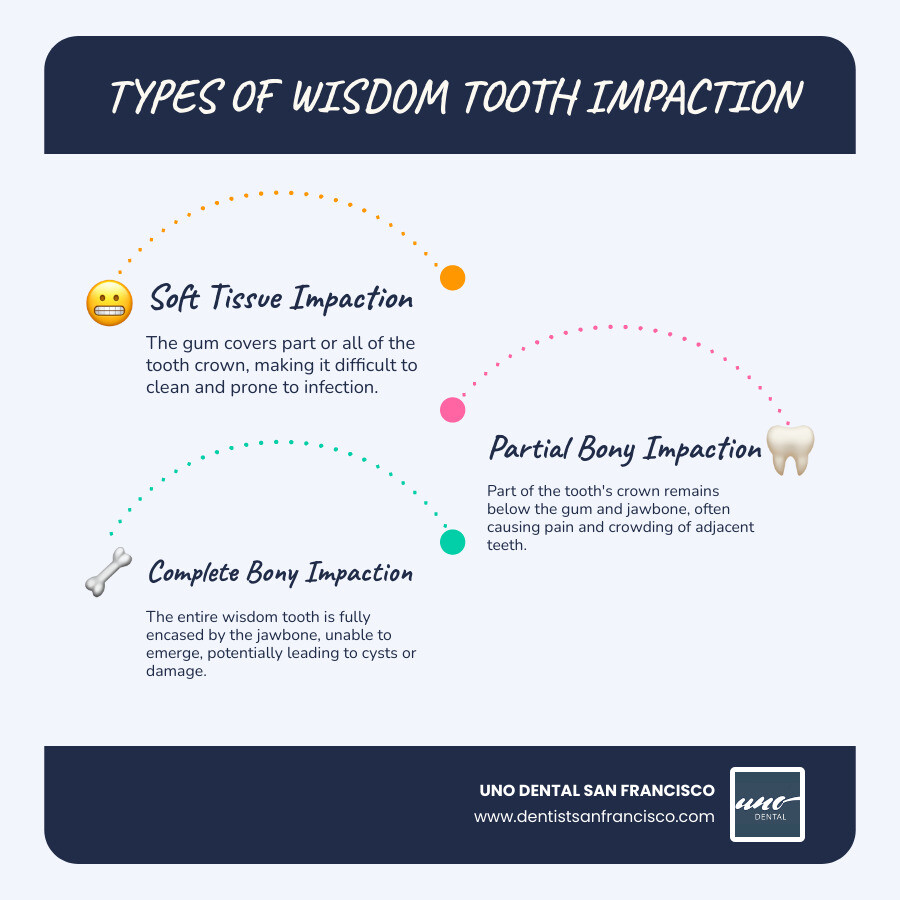
One of the most common issues we see is impacted wisdom teeth. This means the tooth is prevented from properly erupting. It might grow sideways, partially emerge, or remain completely trapped beneath the gum and bone. According to the American Association of Oral and Maxillofacial Surgeons, impacted wisdom teeth can cause significant discomfort and damage. They can push against existing teeth, leading to crowding and alignment problems that can undo years of orthodontic work.
The potential damage to adjacent teeth is another major concern. An impacted wisdom tooth pressing against the second molar can lead to root resorption (where the root of the healthy tooth is dissolved), or make the area difficult to clean, increasing the risk of decay and gum disease in both teeth.
Furthermore, impacted wisdom teeth create an environment ripe for infection. When a wisdom tooth partially erupts, a flap of gum tissue can form over it, trapping food particles and bacteria. This can lead to a painful infection called pericoronitis, which causes swelling, stiffness, pain, and sometimes even illness and swollen lymph nodes. The most serious problems, though less common, include the formation of cysts or tumors around the impacted tooth. These can silently destroy jawbone and healthy teeth over time, sometimes without immediate pain.
Symptoms indicating wisdom teeth removal is needed:
- Persistent jaw pain or tenderness in the back of the mouth
- Swelling of the gums, jaw, or cheeks
- Difficulty opening the mouth fully or pain when chewing
- A bad taste in the mouth, often due to decay or infection
- Red, swollen, or bleeding gums around the wisdom tooth
- Crowding or shifting of other teeth
- Headaches originating from jaw tension
We often recommend proactive removal of wisdom teeth, especially when they are asymptomatic, to prevent these serious complications from developing. Studies have shown that early evaluation and treatment result in a superior outcome for the patient, reducing surgical risk and improving healing.
The ideal age for wisdom teeth removal is generally in the late teens to early twenties (between 17 and 25 years old). At this age, the roots of the wisdom teeth are not fully developed, and the surrounding bone is softer, making the extraction procedure easier and recovery quicker. This proactive approach minimizes the risk of future complications.
While early removal is often ideal, we also perform adult wisdom teeth removal. Can adults have their wisdom teeth removed? Absolutely. While the procedure might be slightly more complex and recovery potentially a bit longer due to more fully formed roots and denser bone, it's a very common and safe procedure for adults. We conduct a thorough assessment to determine the best course of action, ensuring that age is not a barrier to achieving optimal oral health. For younger patients, we provide specialized care and a comfortable environment, ensuring the unique needs of teenagers and young adults are met with expertise and compassion.
The Complete Process for Wisdom Teeth Removal in San Francisco
When you choose UNO DENTAL for your wisdom teeth removal San Francisco, you're opting for a comprehensive, patient-centered experience designed for comfort and optimal results. Our process is meticulous, from your first visit to your full recovery.

The journey begins with an initial consultation process. During this appointment, we conduct a thorough oral examination and discuss your medical history. This is where we listen to your concerns, answer your questions, and start building a personalized treatment plan.
A crucial part of our planning involves advanced imaging (X-rays, 3D scans). We use state-of-the-art panoramic or digital X-rays to get a complete picture of your wisdom teeth's position, root development, and their relationship to surrounding structures, including nerves and sinuses. This precise planning helps us anticipate any complexities and promote the safest, most efficient procedure. For certain cases, 3D imaging provides even greater detail, allowing for highly accurate surgical execution.
Based on this comprehensive evaluation, our team at UNO DENTAL creates a personalized treatment plan just for you. We walk you through every step, explaining the recommended approach, anesthesia options, and what you can expect before, during, and after surgery.
To support your safety and comfort, we provide detailed instructions on how to prepare for surgery, which may include:
- Fasting for a certain number of hours before the procedure, especially if IV sedation or general anesthesia is used.
- Arranging transport: You will need a responsible adult to drive you home after the procedure, as you will not be able to drive under the effects of anesthesia.
- Reviewing and updating us on any current medications or allergies.
- Avoiding smoking or alcohol before your appointment.
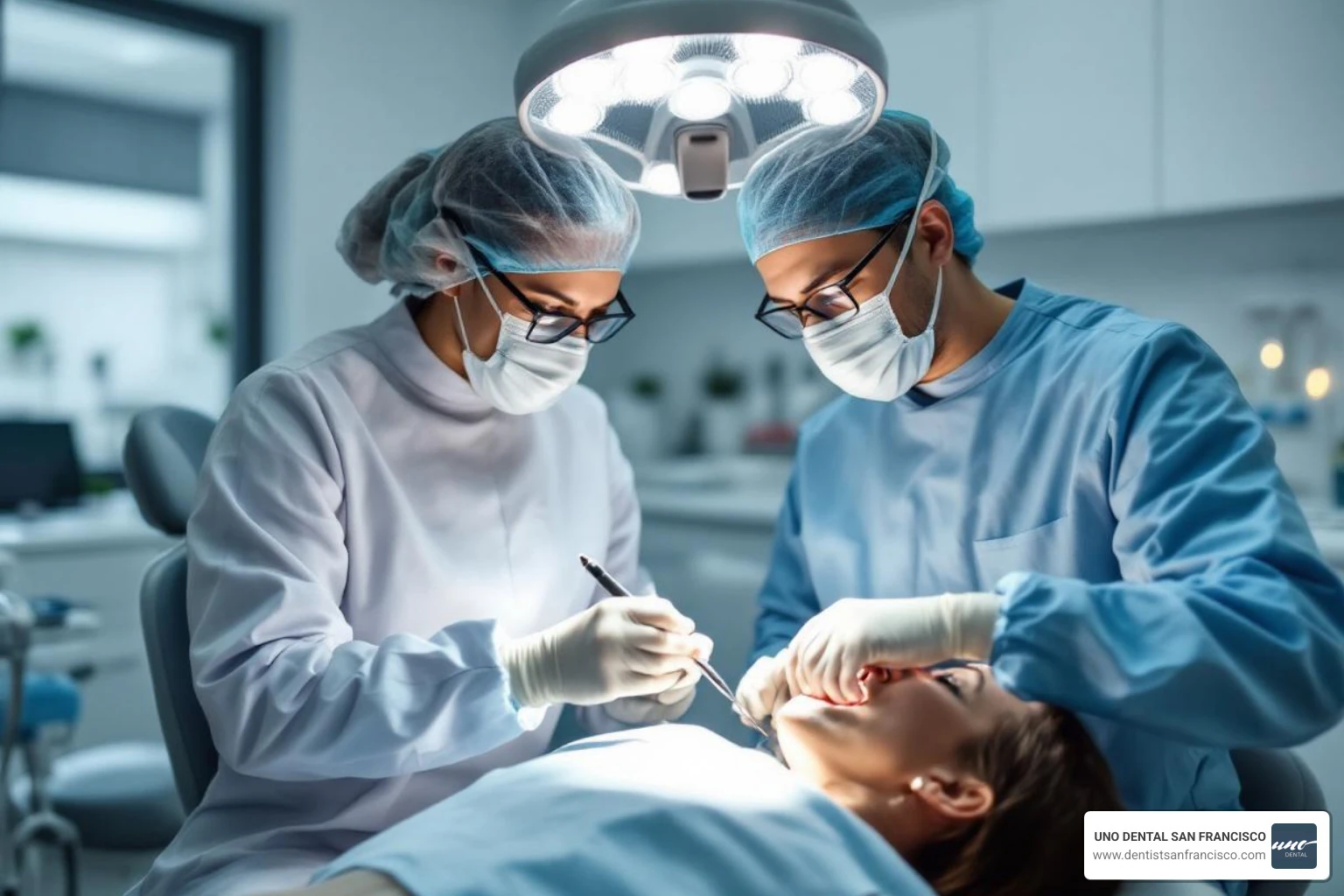
The wisdom teeth removal San Francisco procedure itself is usually surprisingly quick. While complexity varies, the procedure duration typically takes 30 to 60 minutes for all four teeth.
Our surgical steps are performed with precision and care:
- Anesthesia administration: We ensure you are completely comfortable and pain-free.
- Incision: A small incision is made in the gum tissue to expose the tooth and bone.
- Bone removal (if necessary): Any bone obstructing access to the tooth is carefully removed.
- Tooth sectioning: If the tooth is impacted or large, it may be divided into smaller pieces for easier removal.
- Removal: The tooth or its sections are gently extracted.
- Cleaning: The surgical site is thoroughly cleaned to remove any debris.
- Sutures: Dissolvable sutures are typically placed to help the gum heal and protect the site.
We offer a range of anesthesia options at UNO DENTAL to match your comfort level and the complexity of your procedure:
| Anesthesia Option | Description |
|---|---|
| Local Anesthesia | Numbs only the treatment area so you remain awake and aware but do not feel pain in the surgical sites. This is often appropriate for straightforward extractions and patients who feel comfortable being awake. |
| IV Sedation | Medication is delivered through a vein to help you relax deeply. You may drift in and out of sleep and have little to no memory of the procedure, while still breathing on your own. Local anesthesia is also used to keep the area numb. |
| General Anesthesia | You are fully asleep under close monitoring. This may be recommended for complex cases, multiple impacted teeth, or for patients with high anxiety or certain medical needs. |
As with any surgical procedure, there are potential risks, though they are uncommon and we take extensive steps to minimize them. These may include temporary irritation or injury to nearby sensory nerves (which can cause altered sensation in the lips, tongue, or chin), sinus-related complications for upper wisdom teeth, infection, bleeding, or delayed healing. We review all relevant risks and benefits with you in detail before proceeding so you can make an informed decision.
In select cases where the roots of a wisdom tooth are very close to important nerves, we may discuss coronectomy as a specialized alternative. This technique involves removing the crown (top) of the tooth while leaving the roots in place when appropriate, with the goal of reducing the risk of nerve injury. We carefully evaluate imaging, your medical history, and your individual anatomy to determine whether this option is suitable for you.
Throughout the entire process, our goal at UNO DENTAL is to make your wisdom teeth removal San Francisco experience as smooth, comfortable, and predictable as possible.
Introduction: What Are Wisdom Teeth?
- Content: The provided intro covers this well. I will ensure the infographic follows directly.
- Keywords: "wisdom teeth removal san francisco"
- Graphics: ``
Why Wisdom Teeth Removal is Often Necessary
- Key Questions Answered: 3, 4, 5, 6, 16, 17
- Relevant Statistics: About 70% of the population requires removal because mouths cannot accommodate more than 28 teeth. Wisdom teeth usually erupt between 17-25. Average mouth holds 28 teeth, not 32.
- Topics to Cover:
- Common issues: impacted wisdom teeth (definition, problems caused), crowding, alignment problems. (Research: "Impacted wisdom teeth can cause overcrowding issues and pain, or make cleaning hectic.")
- Potential damage to adjacent teeth (Research: "damage to nearby teeth (second molars)", "resorption of adjacent teeth")
- Risks of cysts, tumors, and pericoronitis (gum infection). (Research: "Pericoronitis", "cysts or tumors that can destroy jawbone and healthy teeth.")
- LIST: Symptoms indicating removal (jaw pain, swelling, bad breath, difficulty opening mouth). (Research: "swelling of gums, jaw, and cheeks; pain in the jaw and back of gums; a bad taste due to decay; and difficulty opening the jaw fully.")
- Benefits of proactive removal. (Research: "early evaluation and treatment result in a superior outcome", "avoid future problems and decrease surgical risk.")
- Ideal age for removal (teens and early 20s). (Research: "between 17 and 25", "Extraction at an early age lowers the risk of nerve injury as roots are not fully grown", "Younger patients also tend to have better bone regeneration and healing capacity.")
- Considerations for adult wisdom teeth removal. (Research: "Can adults have their wisdom teeth removed?", "Yes, adults can have extractions at UNO DENTAL")
- Tone: Informative, slightly reassuring about the necessity.
- Humor: Perhaps a light touch about our ancestors' larger jaws.
The Complete Process for Wisdom Teeth Removal in San Francisco
- Key Questions Answered: 7, 8, 9, 11, 12, 18
- Relevant Statistics: Procedure typically takes 30-60 minutes.
- Topics to Cover:
- IMAGE: Modern, clean dental surgery suite at UNO DENTAL SAN FRANCISCO
- Initial consultation process. (Research: "What should I expect at my first appointment?")
- Use of advanced imaging (X-rays, 3D scans) for precise planning. (Research: "X-rays", "3D")
- Personalized treatment planning by UNO DENTAL specialists.
- How to prepare for surgery (fasting, arranging transport). (Research: "Pre-surgery instructions", "Arrange for a friend or family member to take you home.")
- Procedure duration (30-60 minutes). (Research: "The wisdom teeth extraction procedure typically takes 30 to 60 minutes.")
- Surgical steps: incision, tooth sectioning, removal, sutures. (Research: "making an incision, removing the wisdom teeth, and suturing the incision with dissolvable stitches.")
- TABLE: Anesthesia options offered at UNO DENTAL (Local Anesthesia, IV Sedation, General Anesthesia). (Research: "local anesthesia, laughing gas (nitrous oxide/oxygen analgesia) or general anesthesia", "IV sedation")
- Discussion of surgical risks (nerve irritation, sinus complications). (Research: "surgical risks include sensory nerve damage and sinus complications.")
- Coronectomy as a specialized alternative when appropriate. (Research: "What is coronectomy and when might it be recommended?", "Coronectomy, a partial tooth removal leaving the root intact, is offered to reduce this risk.")
- Tone: Professional, reassuring, detailing the high-tech, patient-centered approach of UNO DENTAL.
Your Recovery Journey: What to Expect After Extraction

Following your wisdom teeth removal San Francisco procedure, a smooth recovery depends on careful post-operative care. At UNO DENTAL, we provide detailed instructions to guide you through the healing process and ensure you are as comfortable as possible.
Immediate Post-Op and Recovery Timeline
Your recovery journey begins the moment your surgery is complete. Most patients can return to work or school within one to two days, though we recommend avoiding strenuous activity for at least a week. While you'll feel much better after a few days, the extraction sites may take about two weeks to fully heal.
Managing Pain and Swelling
- Pain Medication: We will provide prescriptions for pain medication or recommend over-the-counter options to manage discomfort as the anesthesia wears off.
- Ice Packs: Applying ice packs to the outside of your cheeks for 20 minutes on and 20 minutes off during the first 24-48 hours is highly effective at reducing swelling and bruising.
Recommended Diet
For the first few days, stick to a diet of liquids and soft foods to avoid irritating the surgical sites.
- Good choices include: Smoothies, yogurt, applesauce, mashed potatoes, soups, and pudding.
- Foods to avoid: Crunchy, hard, spicy, or very hot foods that could dislodge the blood clot or get stuck in the socket.
Oral Hygiene for Optimal Healing
- First 24 Hours: Do not rinse your mouth, spit, or brush your teeth.
- After 24 Hours: You can begin gently rinsing your mouth with a warm salt water solution (1/2 teaspoon of salt in a cup of warm water) after meals and before bed. You may resume brushing your teeth, but be very careful to avoid the surgical areas.
Preventing Dry Socket
A dry socket is a painful condition that occurs if the protective blood clot in the extraction site is dislodged. To prevent this:
- Do not use straws for at least one week.
- Do not smoke or use tobacco products, as this can severely impair healing.
- Avoid vigorous spitting or rinsing.
- Sneeze with your mouth open to avoid creating pressure in your sinuses.
By following these instructions, you can promote faster healing, minimize discomfort, and prevent complications. Our team is always available to answer any questions you may have during your recovery.
Choosing Your Provider and Understanding Costs
Finding the Right Specialist for Wisdom Teeth Removal in San Francisco
Selecting the right team for wisdom teeth removal San Francisco makes a significant difference in your comfort, safety, and long-term oral health. At UNO DENTAL SAN FRANCISCO, we focus on combining advanced technology with a warm, personalized approach so you feel informed and supported at every step.
For many patients, the ideal provider is a dentist or oral surgery team with specialized training and extensive experience in managing impacted wisdom teeth, complex extractions, and sedation. Our clinicians have advanced surgical training and stay current with the latest techniques, which helps us perform precise, efficient procedures while aiming to minimize discomfort and recovery time.
We believe exceptional care goes beyond technical expertise. When you visit UNO DENTAL SAN FRANCISCO, you will notice our patient-centered philosophy:
- We take time to explain your imaging and treatment options in clear, simple language.
- We tailor anesthesia choices to your comfort level and medical needs.
- We emphasize prevention and long-term oral health, not just “fixing a problem.”
- We use high-tech tools and digital planning to support accuracy and safety.
Our holistic perspective means we look at how your wisdom teeth, bite, jaw joints, and overall health interact. This allows us to design treatment plans that support your entire smile, not just one tooth.
What to Bring to Your First Consultation
To make your first wisdom teeth removal San Francisco visit as smooth and productive as possible, we recommend bringing:
- Photo ID (such as a driver’s license or passport)
- Health insurance card and any dental insurance information
- List of current medications and any allergies
- Doctor’s or dentist’s referral, if you have one
- Recent dental X-rays, if available (we can also take new images as needed)
- A list of questions or concerns you would like us to address
Having these items on hand helps us quickly verify your information, coordinate benefits, and focus our time together on understanding your needs and planning your care.
Understanding the Cost of Wisdom Teeth Removal in San Francisco
We know that cost is an important consideration when planning wisdom teeth removal San Francisco. At UNO DENTAL, we are committed to transparency so you understand exactly what is involved financially before moving forward.
Several factors influence the overall fee for wisdom tooth extraction:
- Number of teeth being removed (one, several, or all four wisdom teeth)
- Type and degree of impaction (fully erupted vs. partially or fully impacted in bone)
- Complexity of the procedure, including root shape and proximity to nerves or sinuses
- Type of anesthesia selected (local anesthesia, IV sedation, or general anesthesia)
- Additional treatments that may be needed, such as bone smoothing, sinus management, or coronectomy
Our team will provide a detailed treatment estimate after your examination and imaging. We clearly outline what is included so you can make informed decisions without surprises.
Dental Insurance and Payment Options
If you have dental insurance, our administrative team will help you:
- Verify your benefits for wisdom teeth extraction
- Estimate coverage for the procedure and anesthesia
- Submit claims and necessary documentation on your behalf
Coverage varies widely between plans, so we encourage you to share your insurance details with us before or during your consultation. We will work with you to maximize any available benefits.
For patients without insurance, or for costs not fully covered, we offer flexible payment options. Our team can discuss:
- Acceptable forms of payment
- Possible payment plans or financing options
- Scheduling treatment in stages when appropriate
Our goal is to make high-quality, technologically advanced care as accessible as possible, while maintaining the standard of service and individualized attention that define UNO DENTAL SAN FRANCISCO.
If you have questions about costs before scheduling, we welcome you to contact our office so we can provide guidance based on your specific situation and help you plan the next step towards comfortable, healthy wisdom teeth removal.
Frequently Asked Questions About Wisdom Teeth Extraction
Is the wisdom tooth removal procedure painful?
During wisdom teeth removal San Francisco at UNO DENTAL, our priority is to keep you as comfortable as possible. We use local anesthesia, IV sedation, or general anesthesia (or a combination) so that you do not feel pain during the procedure.
It is normal to experience some soreness, swelling, or mild discomfort afterward as the numbing wears off. We provide clear instructions and, when appropriate, prescribe or recommend pain medication to help you stay comfortable during the first few days. Most patients find that discomfort significantly improves within 3 to 5 days and continues to decrease as healing progresses.
Can adults have their wisdom teeth removed?
Yes. Adults can absolutely have their wisdom teeth removed at UNO DENTAL SAN FRANCISCO. While many people have extractions in their late teens or early twenties, some do not experience problems until later in life, or they may have deferred treatment in the past.
In adults, the roots of wisdom teeth are usually more fully formed and the surrounding bone can be denser, which may make the procedure more complex and recovery slightly longer. However, with careful imaging, planning, and technique, we routinely and safely perform wisdom tooth extractions for adult patients.
During your consultation, we evaluate:
- The position and condition of each wisdom tooth
- The health of nearby teeth and gums
- Your overall medical history and any medications
Based on this assessment, we design a personalized treatment plan that balances your current symptoms, future risk of problems, and your preferences for timing and anesthesia.
When is the ideal age for removal in teenagers?
For many patients, the ideal time to evaluate wisdom teeth is in the mid- to late-teen years. We often recommend an initial assessment around ages 15–17. At this stage:
- Wisdom tooth roots are typically not fully developed, which can make removal easier.
- The jawbone is generally more flexible and responsive, supporting smoother healing.
- We can address potential problems before they cause pain, damage, or crowding.
When imaging shows that wisdom teeth are unlikely to fit properly or are developing in a problematic position, early removal (usually between 17 and 25 years old) can:
- Reduce the risk of nerve injury and other complications
- Shorten recovery time
- Help protect orthodontic results and prevent crowding
At UNO DENTAL SAN FRANCISCO, we are experienced in caring for teen and young adult patients. We take time to explain the process in age-appropriate language, involve parents or guardians as needed, and create a calm, reassuring environment. Our goal is to make wisdom teeth removal a straightforward, manageable experience that supports a healthy smile into adulthood.
Conclusion: Your Next Step to a Pain-Free Smile
Proactively managing your wisdom teeth is a crucial step toward lifelong oral health. By addressing impacted or problematic teeth, you not only find relief from current pain but also prevent future complications like infection, crowding, and damage to neighboring teeth. At UNO DENTAL SAN FRANCISCO, we combine advanced surgical techniques with compassionate, personalized care to make your wisdom teeth removal San Francisco experience as smooth and comfortable as possible.
If you are experiencing symptoms or simply want to understand your options, we encourage you to take the next step. Schedule a consultation with our expert team for a comprehensive evaluation and a treatment plan tailored specifically to your needs. Let us help you achieve a healthy, pain-free smile.
To learn more about our state-of-the-art facility and patient-centered approach, visit our page on our dental clinic in San Francisco.