

Are 3D Printed Dental Crowns Right for You?
3D printed dental crowns are custom tooth restorations built layer by layer using digital files and dental-grade resin, instead of being carved from a ceramic block or made by hand in a lab.
Here is a quick comparison to help you decide:
| Feature | 3D Printed Crown | Traditional Crown |
|---|---|---|
| Production time | Under 20 minutes to print | Days to weeks |
| Appointment type | Often single-visit | Usually 2+ visits |
| Material | Ceramic-hybrid resin | Zirconia, porcelain, metal |
| Fit accuracy | ~91 µm marginal gap | Varies by method |
| Best for | Temporary or select permanent use | Long-term permanent use |
| Impressions needed | Digital scan only | Physical mold or digital scan |
The short answer: 3D printed crowns are fast, precise, and increasingly viable for permanent restorations - but the right choice depends on your tooth, your bite, and your goals. This guide walks you through everything you need to know to compare your options confidently.
Getting a crown used to mean two appointments, a goopy impression tray, and a week or two waiting for a lab to ship your restoration back. That experience is changing fast.
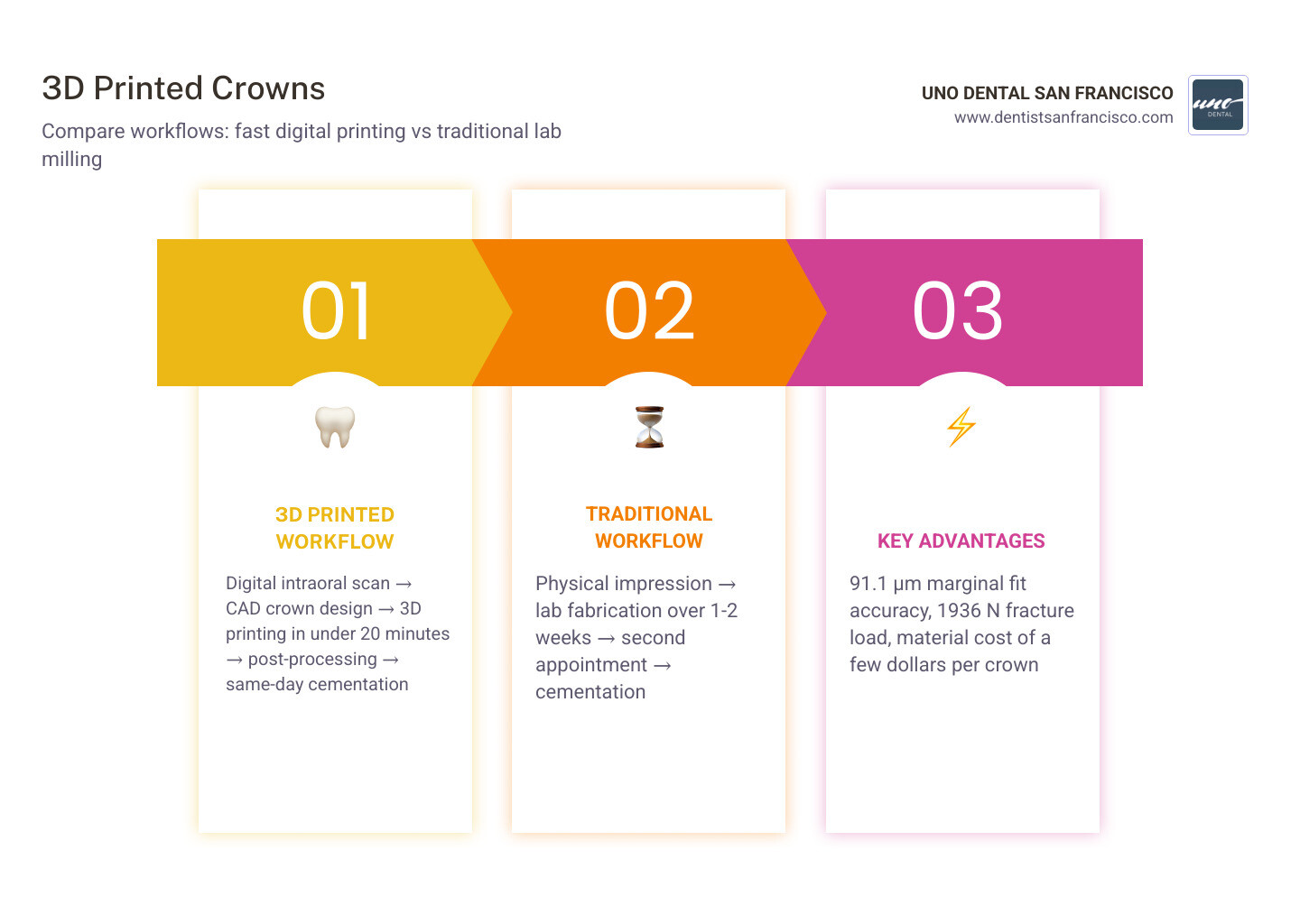
Digital dentistry has made it possible to scan your tooth, design a crown on screen, print it in under 20 minutes, and cement it the same day. The materials have improved dramatically too. Modern ceramic-filled resins can withstand over 1,900 N of biting force - well above what most people generate during normal chewing.
But 3D printed crowns are not a one-size-fits-all solution. There are real differences in strength, aesthetics, and longevity compared to milled zirconia or porcelain. Understanding those differences is what will help you make the right call for your smile.
I'm Mohammad Aghiad Kandar, DDS, and with over 15 years of clinical experience - including advanced training in intraoral scanning and restorative techniques at UCSF - I have followed the rise of 3D printed dental crowns closely, integrating digital workflows into patient care at UNO DENTAL SAN FRANCISCO. Let's break down exactly how this technology works, where it excels, and where traditional methods still hold an edge.
3D printed dental crowns terms you need:
The Clinical Benefits of 3D Printed Dental Crowns
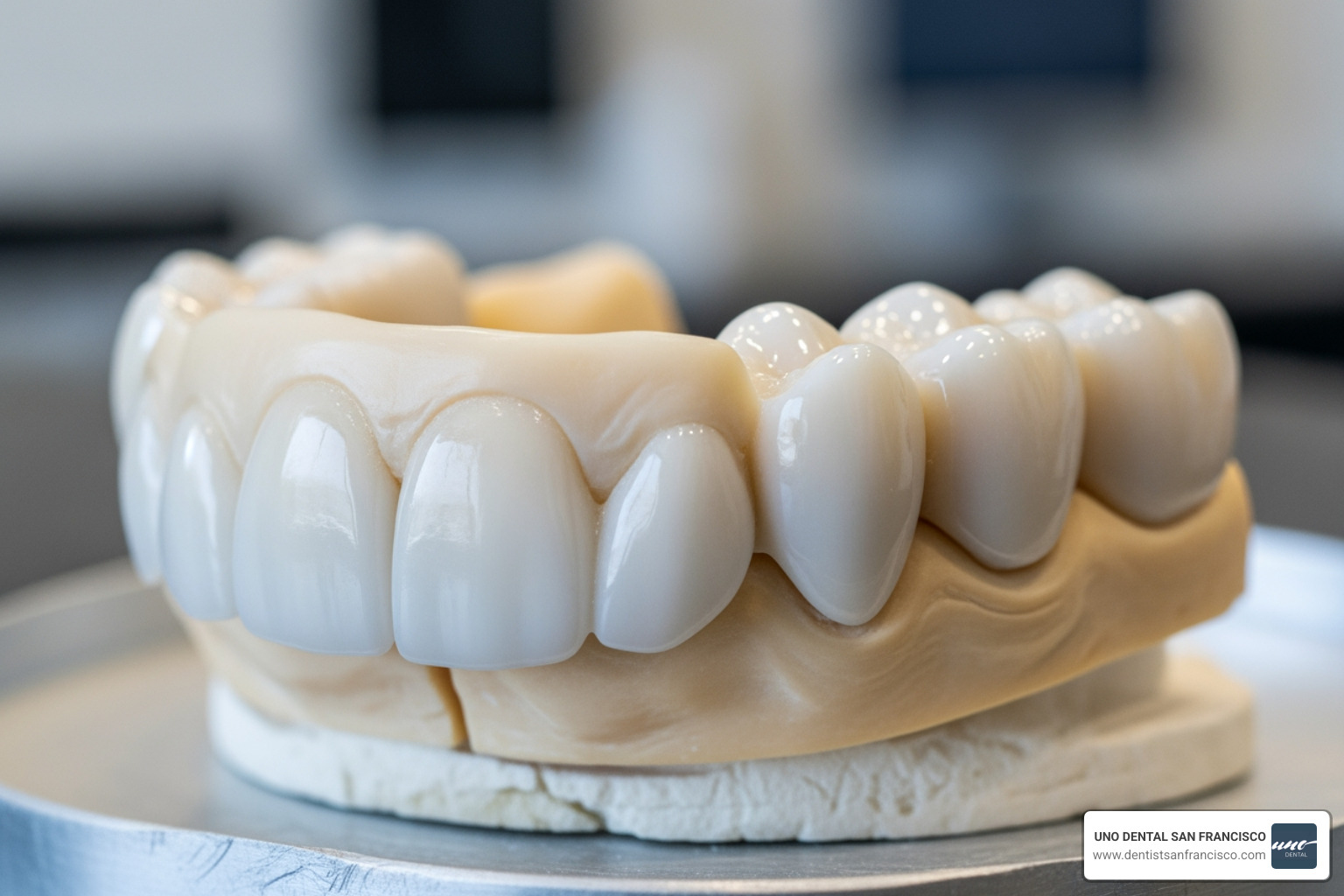
When we talk about 3D printed dental crowns, we are discussing "additive manufacturing." Unlike traditional milling, which carves a crown out of a solid block (subtractive), 3D printing builds the crown from the ground up, layer by microscopic layer. This shift in production offers several clinical advantages that directly impact your comfort and the health of your tooth.
One of the most significant benefits is material efficiency. Because we only use the exact amount of resin needed to form the crown, there is significantly less waste compared to milling. More importantly, the Scientific research on 3D printing of dental prostheses suggests that this technology allows for highly customized, minimally invasive restorations that can be produced in minutes right here in our San Francisco office.
The Evolution of 3D Printed Dental Crowns
The journey of the 3D printed crown began with basic resins used primarily for diagnostic models. Today, we utilize advanced technologies like Stereolithography (SLA) and Digital Light Processing (DLP).
SLA uses a precise laser to cure liquid resin, while DLP uses a digital projector screen to flash an image of the entire layer at once. Both methods have evolved to work with ceramic-filled hybrid resins. These aren't just "plastic" anymore; they are sophisticated composites that mimic the light-reflecting properties and wear patterns of natural enamel.
Precision and Fit Standards
A crown is only as good as its "seal." If the gap between the crown and your natural tooth is too large, bacteria can seep in, leading to decay or gum disease.
Research has shown that 3D printed dental crowns achieve incredible precision. For instance, the Research on marginal and internal fit of 3D-printed restorations indicates that printed crowns can achieve a mean marginal fit of approximately 91.1 μm. To put that in perspective, anything under 120 μm is considered clinically excellent. Furthermore, 3D printed restorations often exhibit better internal adaptation—how well the "inside" of the crown hugs your tooth—than milled versions because the printer can recreate complex internal geometries that a milling bur might struggle to reach.
The Digital Workflow: From Scan to Final Fit

At UNO DENTAL, we embrace a digital workflow that prioritizes your time. The process is entirely "clean"—meaning no trays of silicone putty in your mouth.
We use advanced intraoral scanners to create a 3D map of your teeth. This data is sent to our design software, where we can customize the crown's shape to perfectly match your bite and the surrounding teeth. We even adjust the "build angle"—the orientation at which the crown is printed—to ensure the highest possible accuracy for the surfaces that touch your gums and adjacent teeth.
Step-by-Step Fabrication Process
- Digital Scanning: We capture a high-definition 3D image of your tooth in seconds.
- CAD Design: Our software creates a custom crown blueprint based on your unique anatomy.
- Nesting and Slicing: The design is prepared for the printer, breaking it down into hundreds of layers.
- Printing: The 3D printer builds the crown. Many modern systems can print a single crown in less than 20 minutes.
- Post-Processing: This is where the crown gains its final strength and beauty.
Post-Processing for Maximum Durability
Once the printer finishes, the crown is in a "green" state—it's the right shape, but not yet at full strength. We follow a strict protocol to ensure longevity:
- Cleaning: An isopropyl alcohol wash removes any uncured resin.
- UV Curing: The crown is placed in a specialized light oven. This final "bake" completes the chemical bonding of the resin, reaching maximum hardness.
- Support Removal: Any tiny supports used during printing are removed using carbide rotary tools.
- Polishing and Glazing: We polish the surfaces to a high gloss to ensure patient comfort and prevent plaque buildup. We may also apply a light-cured glaze for a lifelike, translucent finish.
Material Science: Strength and Aesthetics
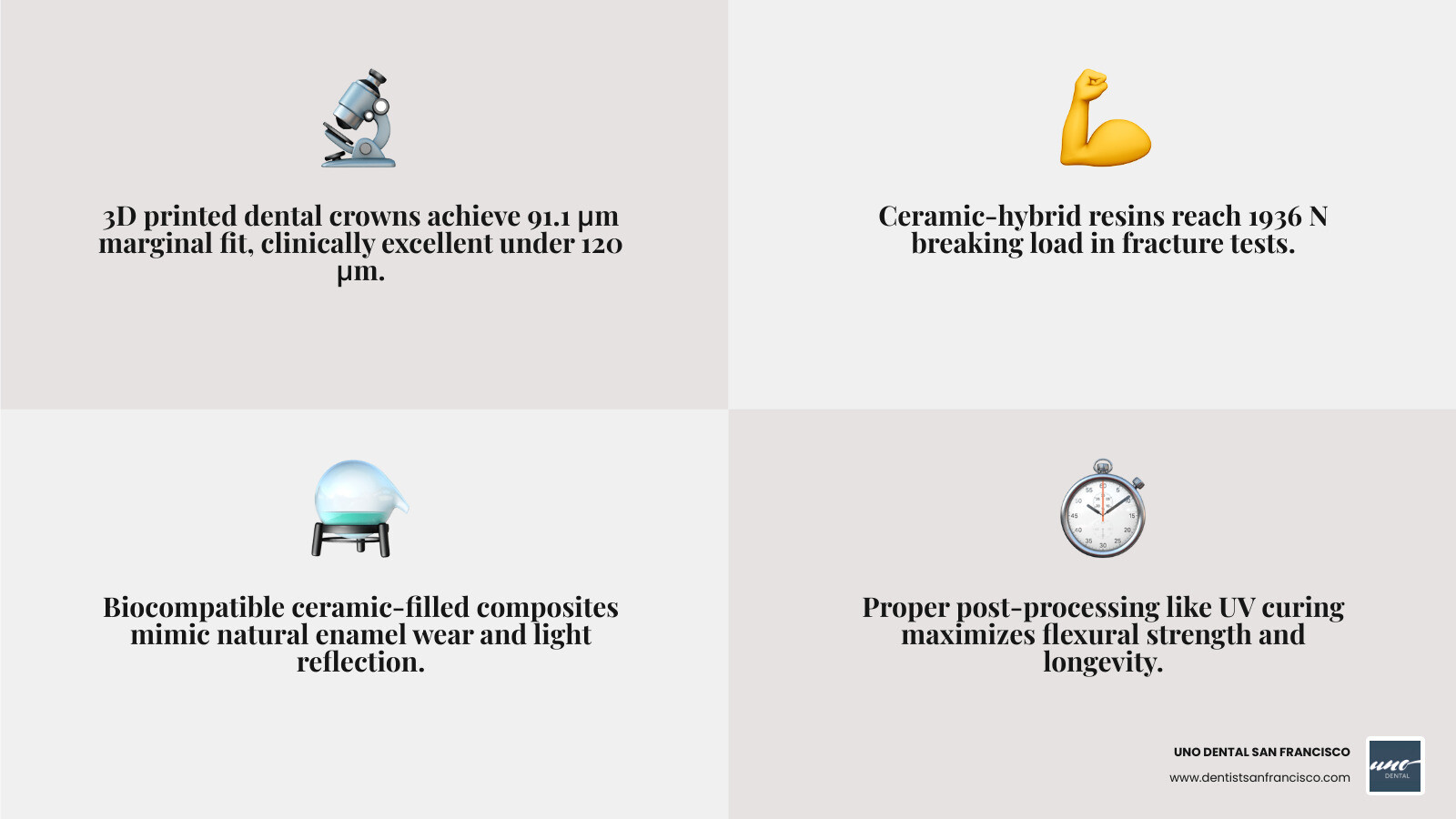
The "magic" of 3D printed dental crowns lies in the ceramic-hybrid resins. These materials are biocompatible, meaning they are designed to live in the human mouth without causing irritation. They are often filled with ceramic particles to provide the necessary "heft" and wear resistance.
A key Study on fracture load and material thickness highlights that the strength of these materials is highly dependent on how they are processed. When handled correctly, these crowns are remarkably tough.
Materials Used in 3D Printed Dental Crowns
We use industry-leading systems such as SprintRay Crown, VarseoSmile, and NextDent. These materials are FDA-cleared and specifically formulated for dental use. Unlike the monochromatic materials of the past, these resins come in various shades (like A1, A2, A3) to blend seamlessly with your natural smile.
Mechanical Performance and Longevity
How strong are they? In initial breaking load tests, high-end 3D printed resins have reached 1936 N. Even after a simulated "10-year chewing test," some materials maintained that exact same strength, showing zero degradation over time.
While they may not yet have the absolute "indestructibility" of solid zirconia, they are more than capable of handling the daily stresses of chewing. They also offer excellent "flexural strength," which means they have a slight elasticity that can be beneficial, especially in pediatric dentistry or as long-term temporaries while a complex implant site heals.
Why Patients Prefer Additive Restorations

The most common feedback we hear from our San Francisco patients is: "That's it? I'm done already?"
The speed of 3D printed dental crowns is a game-changer. We can often provide same-day crowns in San Francisco in a single appointment. This means no "temporary" crown that might fall off over the weekend, and no second shot of numbing medicine two weeks later.
Speed and Efficiency
Because the material cost for a 3D printed crown is often just a few dollars, and the 3D printing solutions are so efficient, we can pass those savings and time-benefits directly to you. A process that once took weeks can now be completed in under an hour.
Accuracy and Comfort
Traditional alginate impressions have an average accuracy error of about 177 μm. Modern 3D printers like the SprintRay Pro have an average RMS accuracy of 129 μm. This higher precision means the crown fits better the first time, requiring fewer adjustments at the chairside.
Furthermore, the digital scanning process is non-invasive and much more comfortable for patients with a strong gag reflex or sensitive teeth.
Frequently Asked Questions about 3D Printed Dental Crowns
Are 3D printed crowns suitable for permanent use?
Yes, certain ceramic-filled hybrid materials are FDA-cleared for definitive (permanent) restorations. However, we often recommend them based on the specific location in the mouth and your individual bite. They are also the gold standard for high-quality interim restorations.
How long does the 3D printing process take?
The actual printing time for a single crown is often less than 20 minutes. When you include scanning, design, and the 15-20 minutes required for post-curing and polishing, the entire clinical workflow can be completed in about an hour.
How does the strength of a printed crown compare to zirconia?
Milled zirconia remains the strongest material in dentistry, often used for patients who grind their teeth heavily. However, 3D printed ceramic-hybrids are significantly stronger than traditional acrylic temporaries and are approaching the durability of some glass-ceramics. They are an excellent "middle ground" option for many clinical situations.
Conclusion
At UNO DENTAL SAN FRANCISCO, we believe that the best dentistry happens when high-tech tools meet holistic, patient-centered care. 3D printed dental crowns are more than just a cool piece of technology; they are a way for us to provide more accurate, more efficient, and more comfortable dental crown services to our community.
Whether you need a quick repair or a complete restorative dentist guide, we are here to help you navigate your options. From our free virtual smile consultations to our high-tech office in the heart of the city, we make it easy to get the smile you deserve.
Ready to see if a 3D printed upgrade is right for you? Explore our dental crowns page or schedule a visit today to experience the future of San Francisco dentistry.