

What Are Full Arch Dental Implants? A Clear Answer First
Full arch dental implants are a permanent, fixed tooth replacement solution that uses four to six titanium implants anchored into your jawbone to support a full set of prosthetic teeth, covering your entire upper or lower arch in one treatment.
Here's a quick snapshot of what you need to know:
| Question | Quick Answer |
|---|---|
| What are they? | Fixed prosthetic teeth supported by 4-6 implants per jaw |
| Are they removable? | No, only a dentist can remove them |
| How long does treatment take? | 3-6 months total; temporary teeth placed same day |
| How long do they last? | Implants 20+ years; prosthetic bridge 15-20+ years |
| How strong is the bite? | 70-80% of natural teeth (vs. 20-25% with dentures) |
| Who is a good candidate? | Most adults with significant tooth loss or failing teeth |
If you've been struggling with loose dentures, damaged teeth, or the prospect of losing most of your teeth, full arch implants offer a stable, long-term solution that looks and functions like natural teeth.
Unlike traditional dentures that sit on your gums and can slip, full arch implants fuse directly with your jawbone through a process called osseointegration. This not only keeps your new teeth firmly in place; it also preserves the bone structure in your jaw, helping maintain your facial shape over time.
The difference in daily life is significant. Patients often describe the transition as transformative: eating comfortably, speaking clearly, and smiling without self-consciousness for the first time in years.
I'm Mohammad Aghiad Kandar, DDS, a restorative and prosthodontic specialist at UNO DENTAL SAN FRANCISCO with over 15 years of experience designing complex treatment plans, including full arch dental implants, for patients who want lasting, natural-looking results. In the sections below, I'll walk you through exactly how the procedure works, what to expect during recovery, and how to decide if this treatment is right for you.
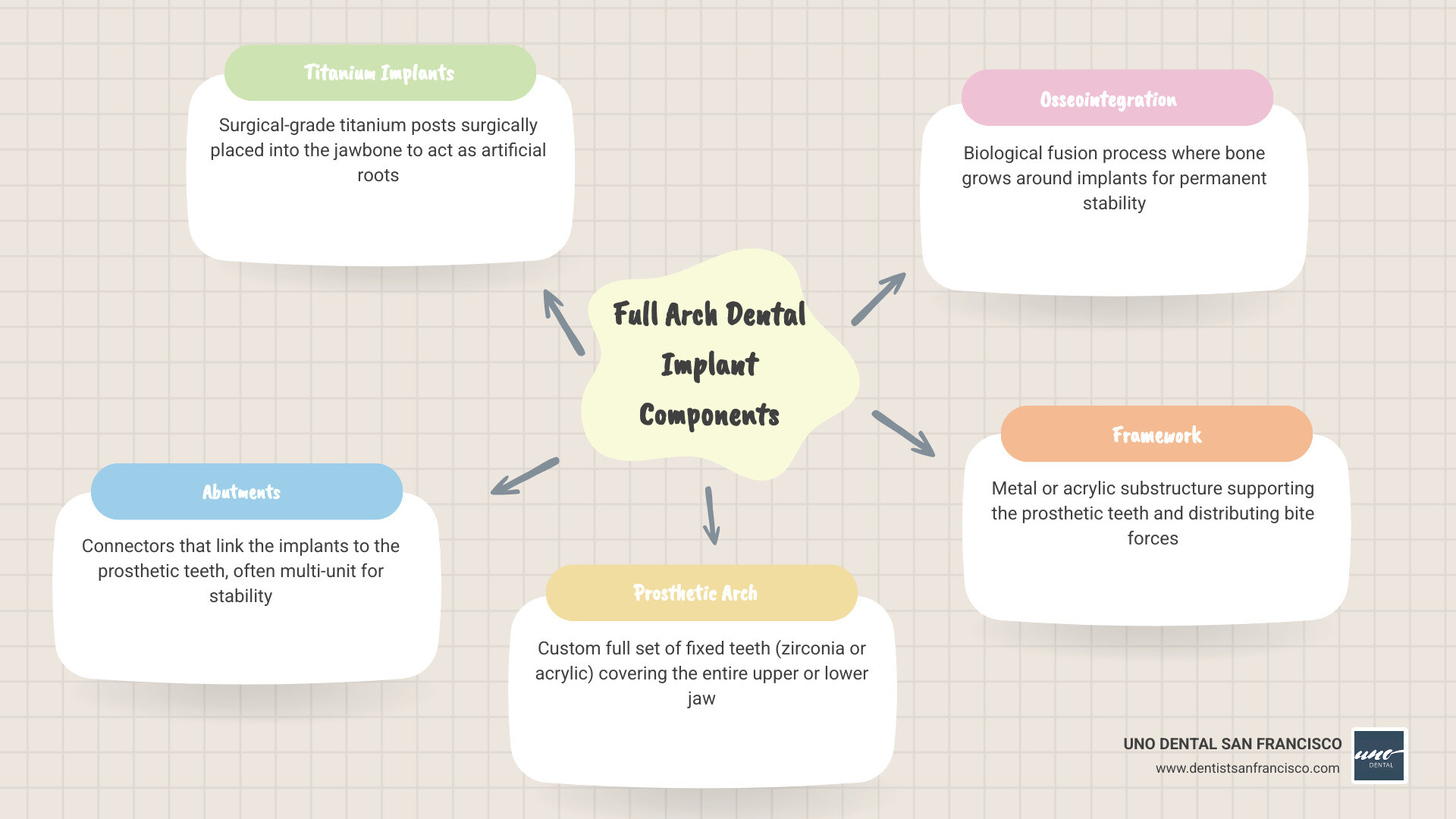
Handy Full arch dental implants terms:
Understanding Full Arch Dental Implants and Their Benefits
When we talk about full-mouth dental implants, we are looking at a shift from traditional tooth replacement methods. For decades, the standard answer to total tooth loss was a removable denture. While dentures provide a basic aesthetic fix, they often fall short of restoring true quality of life.
The primary advantage of Full arch dental implants is the restoration of bite force. While traditional dentures only provide about 20-25% of the chewing power of natural teeth, a full arch implant system restores that power to an impressive 70-80%. This means you can return to enjoying steak, apples, and crunchy vegetables without fear of your teeth slipping or clicking.
Furthermore, implants address the "hidden" consequence of tooth loss: bone resorption. When a tooth root is missing, the jawbone no longer receives the stimulation it needs to stay dense. Over time, the bone melts away, leading to a collapsed facial appearance. Because titanium is biocompatible, the bone actually fuses to the implant, tricking the body into maintaining that bone density. According to scientific research on full arch restoration success rates, these procedures boast an overall success rate between 90% and 100%.
| Feature | Traditional Dentures | Full Arch Implants |
|---|---|---|
| Stability | May slip or click; requires adhesives | Fixed permanently; no movement |
| Bite Strength | 20-25% of natural force | 70-80% of natural force |
| Bone Health | Accelerates bone loss | Prevents bone loss (Osseointegration) |
| Maintenance | Must be removed and soaked nightly | Brushed and flossed like natural teeth |
| Taste/Feel | Palate coverage can block taste | No palate coverage; feels natural |
The Science of Stability: How Full Arch Systems Work
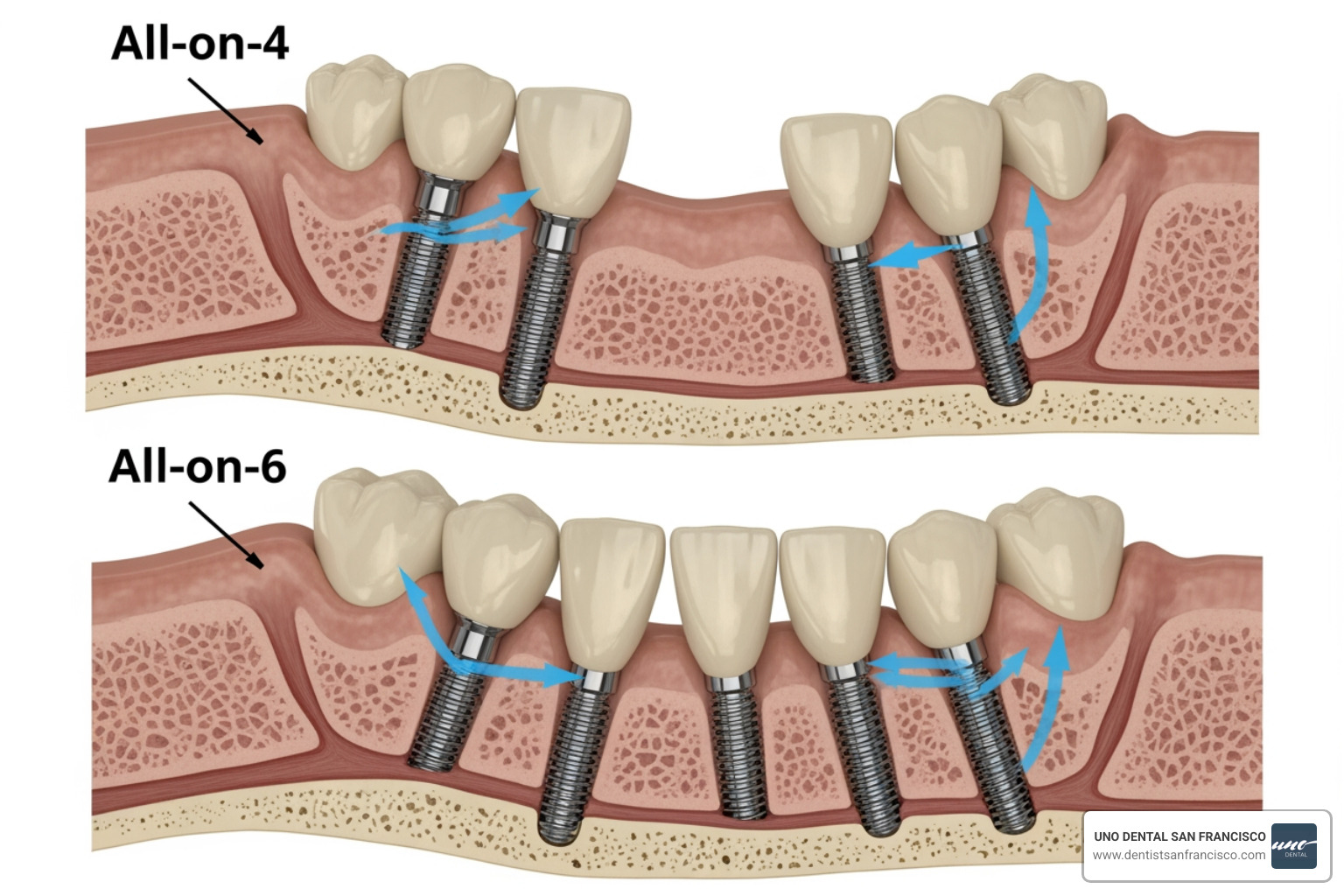
How can just four to six implants support an entire bridge of 12 to 14 teeth? The answer lies in biomechanical engineering. By strategically placing implants at specific angles, often tilting the posterior implants, we can maximize the use of available bone and create a wide "foundation" for the prosthetic.
The cornerstone of this stability is osseointegration. This is the biological process where the jawbone grows around the titanium post, making it a literal part of your anatomy. This process is so effective that scientific research on immediate loading of mandibular restorations shows that patients can often receive functional (though temporary) teeth the very same day the implants are placed.
We typically utilize several configurations based on your unique bone density:
- All-on-4: Uses four implants, with the back two tilted to avoid the need for bone grafting.
- All-on-6: Provides extra redundancy and stability, often recommended for patients with softer bone or a very strong bite.
- Zygomatic Implants: For patients with extreme bone loss in the upper jaw, these longer implants anchor into the cheekbone (zygoma) instead of the jawbone.
Understanding these All-on-4 benefits and candidacy is a key part of our initial consultation process here in San Francisco.
The Full Arch Dental Implants Procedure: A Step-by-Step Guide
At UNO DENTAL, we pride ourselves on a high-tech, streamlined workflow. We don't believe in surprises, so we map out the entire full mouth implant procedure before we ever begin.
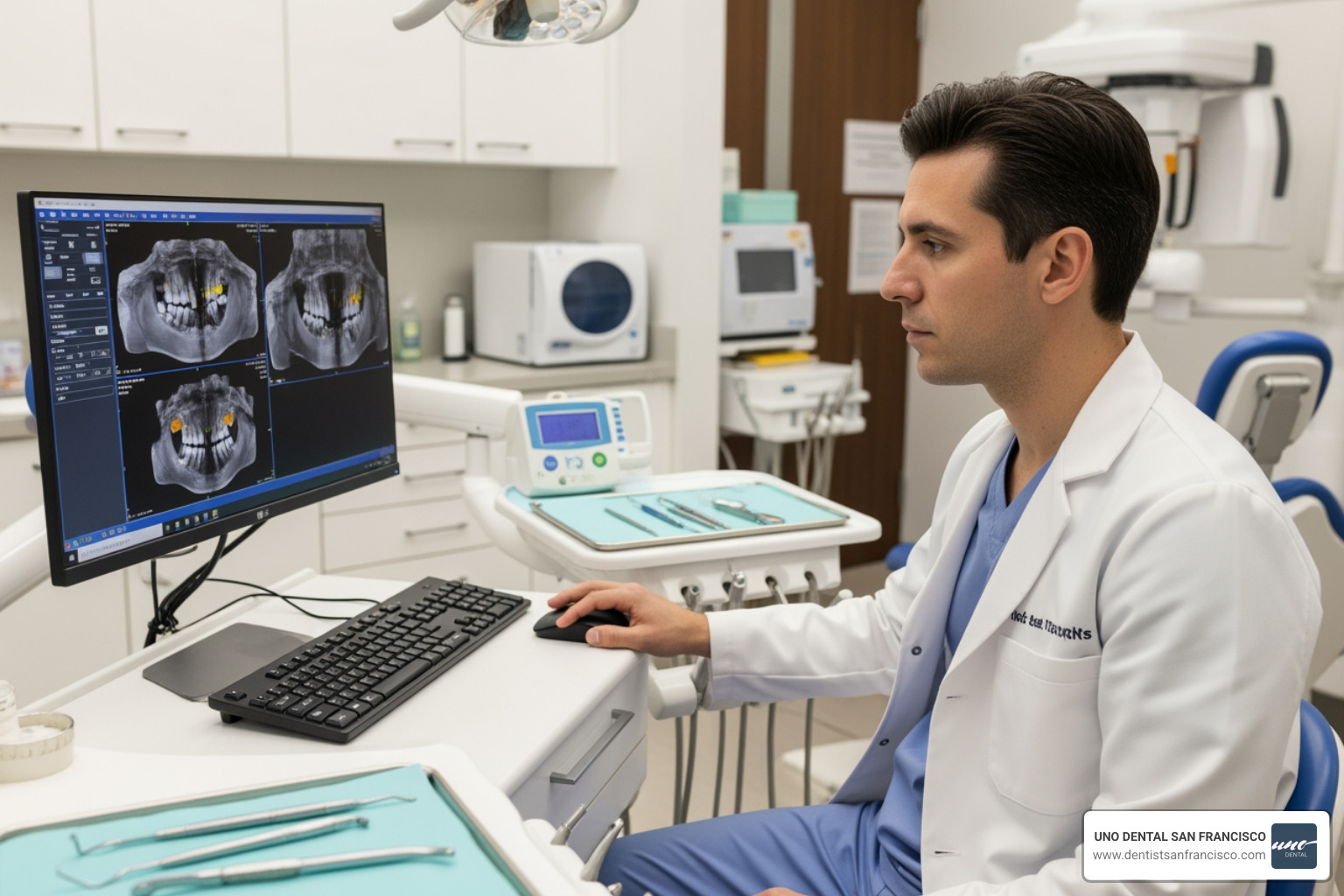
The modern standard for this surgery involves a "fully digital workflow." According to scientific research on digital prosthetic workflows, using integrated digital tools significantly improves the accuracy and speed of the restoration.
Preparing for Your Full Arch Dental Implants
The journey begins with a comprehensive evaluation. We use Cone Beam Computed Tomography (CBCT) to create a 3D map of your jaw, nerves, and sinus cavities. This allows us to virtually "place" the implants on a computer screen before the actual surgery.
- Digital Impressions: No more messy putty; we use intraoral scanners for precision.
- Surgical Guides: A 3D-printed template that fits over your gums to ensure implants are placed at the exact depth and angle planned.
- Extractions: If any failing teeth remain, they are typically removed during the same appointment as the implant placement.
The Transition to Permanent Prosthetics
A common question we hear is: "Will I be toothless while I heal?" The answer is a resounding no. We provide "same-day teeth," which is a provisional (temporary) bridge attached to the implants immediately after surgery.
During the next 3 to 6 months, your bone will undergo osseointegration. Once the implants are fully fused, we swap the temporary bridge for your final, high-strength prosthetic. You can explore more about full mouth restoration options to see which materials, such as Zirconia or high-grade acrylic, best suit your aesthetic goals.
Recovery, Longevity, and Investment in Your Smile
Recovery from Full arch dental implants is often much smoother than patients anticipate. While you may experience some swelling and bruising for the first 3 to 5 days, most of our San Francisco patients return to work within a week.

Managing the Investment
We understand that this is a significant financial decision. The full arch implant cost varies based on the number of implants and the material used for the final bridge. However, when you consider that traditional dentures need to be replaced every 5-7 years and require expensive adhesives and relines, implants often prove to be the more cost-effective long-term solution.
Longevity and Care
How long do they last? With proper care, the titanium implants themselves are designed to last a lifetime. The permanent bridge typically lasts 15 to 20 years or longer. Scientific research on 10-year survival rates confirms high survival rates (up to 98.8%) even after a decade of use.
- Daily Care: Use a water flosser and a soft-bristled brush.
- Professional Maintenance: Visit us every 6 months for specialized cleanings where we check the integrity of the screws and the health of the surrounding tissue.
Frequently Asked Questions about Full Arch Dental Implants
Who is a candidate for full arch implants?
Most adults with significant tooth loss or failing teeth are excellent candidates. During your consultation at UNO DENTAL SAN FRANCISCO, we use 3D CBCT scans to evaluate your bone density and oral health. The specialized angled placement used in full arch systems often eliminates the need for bone grafting, making the procedure accessible even for those with some bone loss.
How do health conditions or smoking affect the success of the procedure?
Systemic health factors, such as managed diabetes, and habits like smoking can influence the healing timeline and the speed of osseointegration. However, they rarely prevent you from receiving Full arch dental implants. We take a holistic approach to your care, working with you to optimize your health and ensure the long-term success of your new smile.
Are full arch implants permanent or removable?
They are permanent and fixed. Unlike "snap-on" dentures that you take out at night, full arch prosthetics are screw-retained. This means they stay in your mouth 24/7 and can only be removed by a dental professional for maintenance. This provides the highest level of stability and confidence.
Can I really get "Same-Day Teeth"?
Yes! This is often called "Smile in a Day." While the final, permanent bridge takes a few months to fabricate after your bone has healed, we can almost always attach a functional, beautiful temporary bridge on the day of surgery. You walk in with failing teeth and walk out with a full, fixed smile.
How long do full arch dental implants last?
As mentioned, the implants are a lifetime investment. The prosthetic bridge is subject to normal wear and tear, much like natural teeth, but modern materials like Zirconia are incredibly durable. Expect the bridge to serve you well for 15 to 20 years or longer before needing any significant refurbishment.
Conclusion: Your New Smile Starts at UNO DENTAL SAN FRANCISCO
At UNO DENTAL SAN FRANCISCO, we believe that everyone deserves a smile that feels as good as it looks. We combine high-tech digital dentistry with a holistic, patient-centered approach to ensure your Full arch dental implants journey is comfortable and successful.
From our individualized treatment plans to our focus on non-toxic materials, we handle every step of your transformation under one roof. If you're ready to bridge the gap and reclaim your confidence, we invite you to take the first step toward a permanent solution.
Ready to see what's possible? Schedule your same-day dental implant consultation or take advantage of our free virtual smile consultation today!