
Navigating Sedation Dentistry and Your Delta Dental Coverage
For many people, the question does delta dental cover sedation dentistry is vital when planning dental care. Dental anxiety or the need for complex procedures can make comfort a top priority. Understanding your insurance benefits upfront helps ease worries about both your treatment and your wallet.
Does Delta Dental cover sedation dentistry?
Delta Dental's coverage for sedation dentistry is not universal. It generally depends on:
- Medical necessity: Is the sedation required for a specific covered procedure (like oral surgery or complex periodontal work)?
- Type of sedation: General anesthesia and IV sedation are more commonly covered than nitrous oxide or oral conscious sedation.
- Your specific plan: Benefits vary widely between Delta Dental plans (PPO, Premier, EPO) and individual policies.
- Provider qualifications: The dentist administering sedation must have appropriate training and state permits.
Sedation is rarely covered purely for convenience or mild anxiety. Always check your plan details and confirm with your dentist. This guide will walk you through the details, helping you understand when and how Delta Dental might cover sedation.
As Dr. Mohammad Aghiad Kandar, DDS, with over 15 years in dentistry, I understand the importance of a comfortable experience. My experience at UNO DENTAL SAN FRANCISCO includes helping patients steer complex questions like does delta dental cover sedation dentistry for their necessary procedures. This commitment to clarity ensures our patients receive the best possible care.
Does delta dental cover sedation dentistry terms to remember:
Understanding the Levels of Sedation in Dentistry
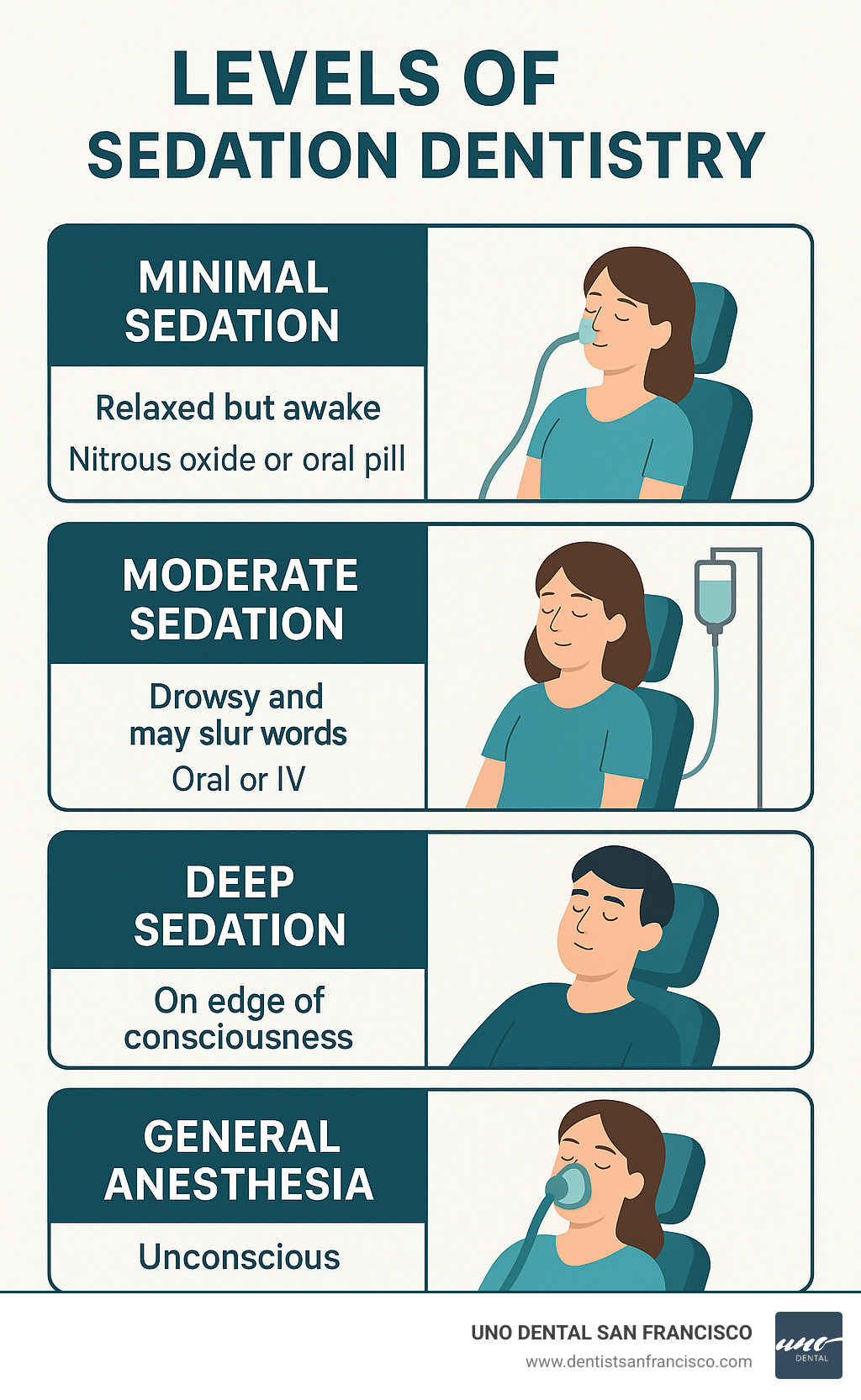
When we talk about sedation in dentistry, it’s certainly not a "one-size-fits-all" scenario! Just like you wouldn't use a tiny band-aid for a big cut, we choose the right level of comfort for your specific needs. The American Dental Association (ADA) has clear guidelines for different types of sedation, all designed to help you feel relaxed and at ease during your dental visit.
Your comfort and safety are always our top priorities. The best choice of sedation depends on a few things: how anxious you feel, your general health, and what kind of dental procedure you're having done. Understanding these different levels is super important, especially when you're asking does Delta Dental cover sedation dentistry, because coverage often changes depending on the type of sedation used.

Minimal Sedation (Anxiolysis)
Think of minimal sedation as taking the edge off. It's the lightest form of sedation, often called "anxiolysis" because its main goal is to simply ease your worries. With this gentle level, you're still completely awake, responsive, and can chat with us or follow any instructions during your appointment. It just helps you feel a little more relaxed and comfortable in the dental chair.
The most familiar way to get minimal sedation is with nitrous oxide, affectionately known as "laughing gas." You breathe it in through a small mask that fits over your nose, and its calming effects come on quickly and fade away just as fast once we remove the mask. This means you can usually drive yourself home after your visit! Sometimes, a small dose of an anti-anxiety pill taken an hour before your appointment can also provide this same mild relaxation.
While minimal sedation is wonderful for mild anxiety or quicker procedures, it's often seen as a "convenience" by insurance companies. This means that when you ask does Delta Dental cover sedation dentistry for nitrous oxide, the answer is often "no," or coverage is very limited. You might find yourself responsible for the full cost.
Moderate Sedation (Conscious Sedation)
Moderate sedation, sometimes called "conscious sedation," takes your relaxation to the next level. While you're technically still awake and can respond if we gently prompt you, you'll be in a much deeper, dreamier state. Many of our patients feel drowsy and might even drift off to sleep. The best part? Lots of people have little to no memory of their dental procedure afterward, which can be a huge relief for those with moderate dental anxiety or for slightly more involved treatments.
There are a couple of ways we can help you achieve this deeper relaxation:
- Oral Conscious Sedation: This involves taking a stronger sedative pill. You'll typically take it before you even arrive at our office. The effects are more profound than minimal oral sedation and can last for several hours, so you'll definitely need a friend or family member to drive you safely to and from your appointment.
- IV Sedation: Administered directly into your bloodstream through an IV line, this method allows us to precisely control your level of relaxation throughout the procedure. It works quickly, and we can easily adjust the medication as needed. It's fantastic for patients with more significant anxiety or for procedures where you need to stay very still.
The American Dental Association (ADA) makes sure that dentists who provide oral and IV moderate sedation have special training and certifications to do so safely. You can always learn more about dental anesthesia and sedation guidelines directly from the ADA's helpful information page on Anesthesia and Sedation. When it comes to does Delta Dental cover sedation dentistry for moderate sedation, you'll often find better coverage for IV sedation, especially if it's considered medically necessary for complex procedures or for patients with specific health needs. Coverage for oral conscious sedation can be a bit more varied, so it's always smart to double-check your plan details.
Deep Sedation and General Anesthesia
Deep sedation and general anesthesia are the most profound levels of comfort we can provide. With deep sedation, you're very relaxed, almost asleep, but can still be roused if needed. With general anesthesia, you are completely unconscious – truly "asleep" – for the entire procedure, and won't remember a thing. These levels are usually reserved for major oral surgery, very extensive treatments, or for patients with extreme anxiety, severe phobias, or special needs who might find it very difficult to cooperate otherwise.
For deep sedation and general anesthesia, the ADA guidelines are very strict. Dentists must have completed advanced training, like an accredited oral surgery or dentist-anesthesiologist residency. This high level of training ensures your absolute safety. Sometimes, for these deeper levels, a separate, highly specialized anesthesiologist will come in to administer and monitor your anesthesia while your dentist focuses entirely on your dental procedure. Depending on your health and the complexity of the treatment, these procedures might even take place in a hospital setting.
When you wonder does Delta Dental cover sedation dentistry for deep sedation or general anesthesia, you'll generally find that coverage is more favorable than for the lighter forms of sedation, especially when it's clearly linked to a medically necessary surgical procedure. However, whether the fee for a separate anesthesiologist is covered can still vary quite a bit from one plan to another.
So, Does Delta Dental Cover Sedation Dentistry?
This is the million-dollar question, and the answer, as with most things insurance-related, is nuanced. Does Delta Dental cover sedation dentistry? Yes, but with significant caveats. Delta Dental's coverage for sedation is primarily driven by concepts of "medical necessity" and "clinical appropriateness." This means they want to see a clear reason why sedation is required beyond just patient preference or mild discomfort.
Your specific Delta Dental plan plays a massive role. Whether you have a PPO, Premier, or EPO plan, and whether it's an individual or group plan, will dictate the extent of your benefits. There are always exclusions and limitations to consider, which we'll dig into shortly.
How Your Specific Plan Answers "Does Delta Dental Cover Sedation Dentistry?"
To truly understand what your Delta Dental plan covers, you need to consult your benefit booklet or Evidence of Coverage (EOC). This document is your go-to source for detailed information about your specific plan's deductibles, coinsurance, annual maximums, and how in-network versus out-of-network providers affect your benefits.
For example, a Delta Dental PPO plan might offer different coverage percentages for in-network dentists compared to out-of-network ones. If you use a PPO network dentist, you'll generally receive the greatest savings and benefits. Delta Dental Premier network dentists also offer benefits, but the out-of-pocket costs might differ slightly. If you choose a non-participating dentist, you might be responsible for the difference between the plan allowance and the dentist's full fee.
Our team at UNO DENTAL SAN FRANCISCO is well-versed in navigating Delta Dental plans. We can help you check your Delta Dental patient eligibility and benefits to get a clear picture of your coverage. This is a crucial step before any treatment involving sedation, as it helps avoid unexpected out-of-pocket expenses.
When Sedation is Covered for Specific Procedures
Delta Dental typically covers General Anesthesia and IV sedation under specific circumstances where it is deemed medically necessary and clinically appropriate. Based on our research and experience, here are some common scenarios where Delta Dental is more likely to cover sedation:
- Surgical Impacted Wisdom Teeth: This is one of the most frequently cited reasons for sedation coverage. Many Delta Dental plans explicitly state that General Anesthesia and IV sedation are covered when associated with covered surgical impacted wisdom teeth.
- Complex Oral Surgery: Beyond wisdom teeth, other extensive oral surgical procedures that cannot be safely or effectively performed with local anesthesia alone may qualify for sedation coverage. This can include complex extractions, bone grafting, or jaw surgery.
- Medically Compromised Patients: Patients with certain underlying medical conditions (e.g., severe heart conditions, uncontrolled diabetes, respiratory issues) that make dental treatment risky or difficult without sedation may receive coverage. Sedation helps manage their health during the procedure.
- Patients with Disabilities: Individuals with physical, cognitive, or developmental disabilities who cannot cooperate for dental treatment in a conventional manner are often candidates for covered sedation. This ensures they can receive necessary care safely and comfortably.
- Severe Documented Phobia/Anxiety: While sedation for convenience is rarely covered, if a patient has a severe, documented dental phobia or extreme anxiety that prevents them from receiving essential dental care, sedation may be considered medically necessary. This often requires thorough documentation from the dentist explaining why other methods are insufficient.
- Selected Endodontic and Periodontal Surgical Procedures: Some plans extend coverage for General Anesthesia or IV Sedation when administered by a provider for selected endodontic (e.g., complex root canals) and periodontal surgical procedures.
Delta Dental of Michigan's clinical criteria document highlights situations where sedation is considered medically necessary: inability to obtain adequate pain control with local anesthesia, medical or behavioral compromising conditions, complexity of dental procedures, or young patients with anxiety/uncooperative behavior where non-pharmacologic methods are insufficient. This aligns with the broader principles across various Delta Dental plans.
Common Limitations and Exclusions
Understanding the limitations and exclusions is just as important as knowing what's covered. Delta Dental plans generally have strict rules about what they won't pay for when it comes to sedation.
- Convenience-Based Sedation: If sedation is requested purely for your convenience or because you'd "prefer" to be sedated, it's highly unlikely to be covered. Insurance providers typically view this as an optional service.
- Nitrous Oxide Coverage: While widely used, nitrous oxide is often not covered by Delta Dental plans, or if it is, it might be covered at a very low percentage or only for specific, limited circumstances. It's frequently seen as a "comfort" service rather than a medical necessity.
- Separate Anesthesiologist Fees: If an anesthesiologist, rather than your treating dentist, administers the sedation, their fees might not be covered, or only partially covered, depending on your plan. Some plans only cover sedation when administered by the dentist performing the procedure in their office and specifically state that a separate charge for general anesthesia and/or IV sedation is not covered if it's billed independently.
- Procedures Not Deemed Medically Necessary: If the underlying dental procedure itself is not covered by your plan (e.g., cosmetic procedures), then any associated sedation will also not be covered. Furthermore, if Delta Dental determines that the level of sedation used was not medically necessary for the procedure performed, they may deny coverage. For instance, if a simple filling is done under IV sedation, it's likely to be denied unless there's a strong, documented medical reason.
- Duration Exceeding Treatment Time: Delta Dental may disapprove benefits if the duration of the sedation exceeds the actual treatment time, or if it's solely for convenience.
It's clear that while the answer to does Delta Dental cover sedation dentistry is "sometimes," it's always contingent on necessity, the type of sedation, and your specific plan's rules.
Why Your Dentist's Training and Permits Affect Coverage
Beyond the type of sedation and the procedure, your dentist's qualifications are a critical factor in Delta Dental's coverage decisions. This isn't just about insurance compliance; it's fundamentally about your safety and the quality of care you receive. Delta Dental, like other reputable insurers, wants to ensure that sedation is administered by highly trained and competent professionals.
ADA Training Requirements for Dentists
The American Dental Association (ADA) sets rigorous guidelines for dentists administering different levels of sedation and anesthesia. These guidelines are designed to ensure patient safety and proper emergency management. Insurance providers often align their coverage policies with these professional standards.
Here's a breakdown of the ADA's requirements for dentists:
- Oral Moderate Sedation: Dentists providing oral moderate sedation must complete a minimum of 24 hours of classroom training. This includes comprehensive education on pharmacology, patient assessment, monitoring, and emergency protocols. Additionally, they must hold current CPR certification, complete a course in managing emergencies, and gain experience with at least 10 supervised patients.
- IV Moderate Sedation: For IV moderate sedation, the requirements are even more stringent. Dentists need to complete 60 hours of classroom training, which digs deeper into IV pharmacology, venous access, and advanced airway management. Like oral sedation, CPR certification and an emergency management course are mandatory. Crucially, they must also have supervised experience with at least 20 IV infusions on patients.
- Deep Sedation and General Anesthesia: For the deepest levels of sedation, the ADA guidelines stipulate that the dentist must complete an accredited oral surgery or dentist-anesthesiologist residency. These are extensive, multi-year programs that provide comprehensive training in advanced anesthesia techniques, patient management, and emergency response in complex medical scenarios.
These requirements ensure that dentists are not only skilled in administering the sedatives but also fully prepared to handle any potential complications. At UNO DENTAL SAN FRANCISCO, we adhere to the highest standards of care, ensuring our team meets or exceeds these rigorous training requirements. You can review the detailed ADA Guidelines for Sedation and Anesthesia for further information.
The Role of State Regulations and Credentials in Claims
In addition to national ADA guidelines, state dental boards have their own specific regulations and permitting processes for dentists administering sedation. These state laws often build upon the ADA guidelines, sometimes adding further requirements.
- State Permits: For moderate, deep sedation, and general anesthesia, most states require dentists to obtain a specific permit or license from the state dental board. This permit signifies that the dentist has met the state's educational, training, and facility requirements for administering that particular level of sedation.
- Qualified Providers: Delta Dental's coverage decisions are directly influenced by whether the administering dentist holds the necessary state permits. If a dentist administers sedation without the proper state credentials, Delta Dental may deny the claim, regardless of medical necessity or the type of procedure. They want to ensure that benefits are paid only for services rendered by legally and professionally qualified providers.
- Claim Approval: When you submit a claim that includes sedation, Delta Dental may cross-reference the dentist's credentials with state board records. The anesthesia record, which details the type and duration of sedation, patient monitoring, and any complications, is a vital piece of documentation that supports the claim and demonstrates adherence to safety protocols.
- Insurance Verification: Our team at UNO DENTAL SAN FRANCISCO understands the importance of this alignment. We carefully verify our dentists' credentials and ensure all state permits are current, minimizing issues with insurance verification and claim approval. This also means we can confidently answer your questions about does Delta Dental cover sedation dentistry in our specific practice setting.
Delta Dental's coverage for sedation isn't just about "what" procedure or "what" type of sedation; it's also heavily about "who" is administering it and whether they meet both national and state-specific qualifications.
How to Confirm Your Sedation Dentistry Coverage
Getting a clear answer to does Delta Dental cover sedation dentistry before your appointment saves you from unwelcome surprises at checkout. Think of it as doing your homework - a little effort upfront can save you hundreds or even thousands of dollars later.
The key is getting what's called a pre-authorization or pre-determination of benefits. This is basically Delta Dental's way of saying "here's what we'll probably cover" before you actually have the treatment done. It's not a guarantee, but it's pretty close.
Steps to Verify Your Benefits Before Treatment
Start by calling Delta Dental directly. Look for that customer service number on your insurance card - it's usually printed right there next to your member ID. When you call, have your information ready: your group number, member ID, and those mysterious procedure codes (called CDT codes) that your dental office can provide.
Next, dig into your Evidence of Coverage (EOC). Yes, it's about as exciting as reading a phone book, but this document holds the real answers about your specific plan. Look for sections mentioning "anesthesia," "sedation," or "general anesthesia." Pay special attention to any fine print about limitations or medical necessity requirements.
The most reliable approach? Ask your dental office to submit a pre-treatment estimate. At UNO DENTAL SAN FRANCISCO, we do this regularly for our patients. We'll send your proposed treatment plan to Delta Dental, complete with specific codes like D9222 for deep sedation or D9239 for IV sedation. Delta Dental reviews everything and sends back an estimate of what they'll cover.
Fair warning - this process takes a few weeks, so don't wait until the day before your procedure to start. But trust me, it's worth the wait to avoid sticker shock.
Key Questions to Ask to Confirm if Delta Dental Covers Your Sedation Dentistry
When you're talking to Delta Dental or your dental office's financial team, asking the right questions makes all the difference. Don't be shy - this is your money we're talking about.
Ask specifically about your procedure and sedation combination. Instead of "Do you cover sedation?" try "Is IV sedation covered when I'm having my impacted wisdom teeth removed?" The more specific you are, the more accurate their answer will be.
Find out which types of sedation your plan actually covers. Some plans cover IV sedation but not nitrous oxide. Others might cover general anesthesia for surgery but exclude oral conscious sedation. Each type has different CDT codes, and Delta Dental treats them differently.
Check if your dentist is in-network. This can dramatically affect your out-of-pocket costs. An in-network dentist at UNO DENTAL SAN FRANCISCO will typically result in lower costs than going out-of-network, especially for sedation services.
Ask about separate anesthesiologist coverage. If your procedure requires bringing in a specialist anesthesiologist, their fees might be billed separately. Some plans cover this, others don't. And if they do cover it, the anesthesiologist might need to be in Delta Dental's network too.
Understand what "medically necessary" means for your plan. This is often the make-or-break factor for coverage. Ask them to explain exactly what documentation or conditions need to be met for your sedation to qualify.
Don't forget about your financial responsibilities. Ask about deductibles, coinsurance percentages, and how sedation affects your annual maximum. Sometimes the sedation is covered, but you're still responsible for 20% or 30% of the cost.
By taking these steps and asking these questions, you'll have a clear picture of your coverage before you sit in the dental chair. It might seem like extra work, but knowing exactly what Delta Dental covers for sedation dentistry in your specific situation gives you peace of mind when you need it most.
Conclusion: Partnering for a Comfortable Dental Experience
Whew! Navigating dental insurance, especially when it comes to something as specific as sedation, can certainly feel a bit like solving a puzzle. But as we've explored, understanding the ins and outs of does Delta Dental cover sedation dentistry is truly the key to feeling confident and comfortable about your dental care.
We've seen that it's rarely a simple "yes" or "no." Instead, coverage often depends on several important factors: Is the sedation medically necessary for your procedure? What type of sedation are you considering? What are the specifics of your Delta Dental plan? And, of course, does your dentist have the right training and permits to administer it safely? Generally, deeper sedation like IV sedation or general anesthesia tends to have better coverage, especially for complex procedures or specific patient needs, while options like nitrous oxide are often considered a personal comfort choice.
The most important takeaway here is all about patient empowerment and proactive communication. You have the power to make informed decisions! By taking a little time to look at your benefit booklet, having a chat with Delta Dental directly, and letting your dental team submit a pre-treatment estimate, you're arming yourself with all the knowledge you need. This helps you avoid any unwelcome surprises when it comes to costs.
At UNO DENTAL SAN FRANCISCO, our passion is providing comprehensive, patient-centered dental services. We believe that clear, honest communication is just as vital as the care itself, especially when it concerns your comfort and your financial peace of mind. We're here to help you understand all your options and ensure your dental experience is as smooth and stress-free as possible.
A truly comfortable dental experience begins long before you even sit in the chair – it starts with clear understanding and thoughtful planning. Please don't hesitate to reach out to us with any questions you have about sedation dentistry and how it might align with your Delta Dental plan.