

Why Dental Anxiety in Kids Is More Common Than You Think
Dental anxiety kids experience is one of the most common challenges parents face when it comes to their child's health. Here's a quick overview of what it means and what you can do about it:
Quick answers for parents:
- What it is: Fear or stress about dental visits, specific tools (like drills or needles), or even just thinking about the dentist
- How common: Affects roughly 9% of children globally, with some regions reporting rates as high as 26%
- Why it matters: Untreated dental anxiety leads to avoided checkups, worsening oral health, and lifelong dental phobia
- What helps: Early visits, positive language, parental modeling, gradual exposure, and professional techniques like nitrous oxide or CBT
Dental anxiety is not just nervousness. It can affect a child's psychological well-being, their oral health, and even their overall physical health. When left unaddressed, it often follows children into adulthood — where avoided checkups turn into bigger, more painful, and more expensive problems. That cycle is exactly what this guide will help you break.
I'm Mohammad Aghiad Kandar, DDS, and with over 15 years of clinical experience — including expertise in sedation dentistry and patient-centered care at UNO DENTAL SAN FRANCISCO — I've worked with many families navigating dental anxiety in kids and helped them build lasting, positive relationships with dental care. This guide brings together the best evidence-based strategies so you can feel confident walking your child through their next visit.
Dental anxiety kids basics:
Addressing Dental Anxiety Kids: Causes and Triggers
Understanding why a child develops a fear of the dentist is the first step toward helping them overcome it. It isn't always about a "bad" experience; sometimes, the brain is simply wired to protect the child from the unknown. Research published in PubMed indicates that approximately 9% of children and adolescents across the U.S., Canada, and Europe suffer from significant dental fear.
The Power of Previous Experiences
One of the most common causes is classical conditioning. If a child had a painful or frightening experience during a past visit—perhaps involving a needle or a loud drill—their brain creates a "danger" association with the dental office. Interestingly, the timing of these experiences matters. The Latent Inhibition Hypothesis suggests that if a child has several positive, easy visits before a difficult one, those positive memories act like a "psychological vaccine," making them less likely to develop long-term anxiety.
Sensory Sensitivity and the Unknown
For many children, the dental office is a sensory minefield. The high-pitched whine of the handpiece, the clinical smell of antiseptic, and the bright overhead lights can trigger a "fight or flight" response. This is especially true for children with sensory processing sensitivities. Furthermore, the "fear of the unknown" plays a massive role. When a child doesn't understand what a tool does or why someone is looking in their mouth, their imagination often fills in the gaps with scary scenarios.
The Role of Parental Modeling
We often say that children are like little sponges. If a parent talks about their own dental "nightmares" or displays visible tension when discussing an upcoming appointment, the child will pick up on those cues. Emotional contagion is real; research shows that a father's or mother's anxiety can be directly transferred to the child. Overcoming dental fear in San Francisco starts with the adults in the room staying calm and positive.
Common Dental Triggers for Kids:
- The Sound of the Drill: High-frequency noises are naturally alarming.
- Needles and Injections: The sight of a syringe is a universal trigger.
- The "Choking" Sensation: Feeling like they can't swallow or have objects too deep in their throat.
- Loss of Control: Being reclined in a chair while someone works on a part of the body they can't see.
- Clinical Smells: Specific chemical scents associated with hospitals or doctors.

Recognizing Warning Signs and Health Consequences
Identifying dental anxiety kids exhibit isn't always as simple as a child saying, "I'm scared." Anxiety often wears many masks, especially in younger children who lack the vocabulary to express complex emotions.
Behavioral and Physical Cues
In the days leading up to an appointment, you might notice behavioral signs such as:
- Increased irritability or "acting out."
- Clinginess or refusal to leave your side.
- Aggressive outbursts when the topic of the dentist is raised.
- Avoidance tactics, such as pretending to be sick or hiding.
Physical symptoms are also common. A child might experience stomach aches, "butterflies," nausea, or even nightmares and sleep disruptions the night before a visit. During the actual visit, signs of distress include white knuckles (gripping the chair), rapid breathing, sweating, or a refusal to open their mouth.
The High Cost of Untreated Anxiety
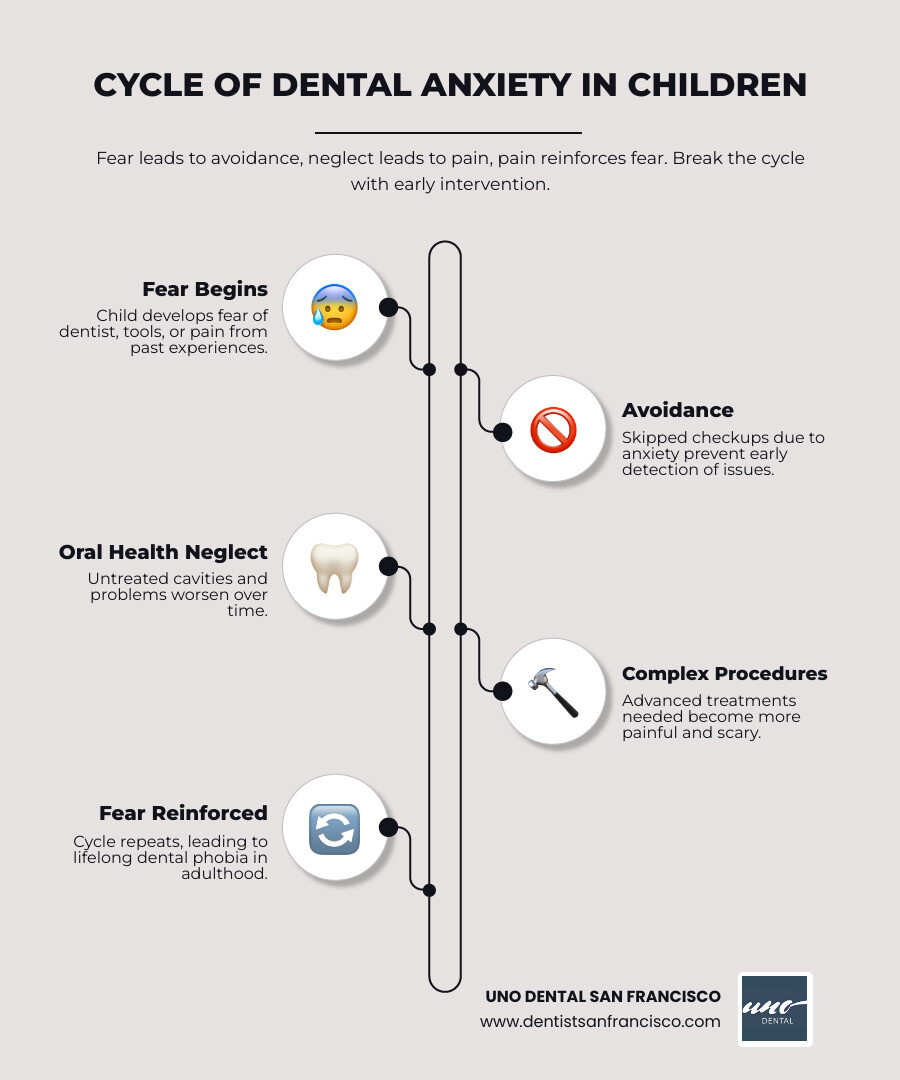
If we allow a child to simply avoid the dentist because they are anxious, we are inadvertently setting them up for significant health problems. This is known as the "cycle of avoidance."
- Neglect of Oral Health: Missing cleanings leads to plaque buildup and undetected cavities.
- Emergency Situations: Small problems become infections or abscesses that require more invasive treatments (like extractions or root canals).
- Reinforced Fear: Because the child only visits the dentist when they are in pain for a "scary" procedure, their fear is validated and worsened.
Long-term, this can lead to adult dental phobia, which affects 10% to 20% of adults in the U.S. By addressing these fears early through proper pediatric dental care, we ensure they grow up with a healthy mouth and a confident smile.
Effective Management Strategies for Parents and Dentists
At UNO DENTAL SAN FRANCISCO, we believe that managing dental anxiety kids feel is a partnership between the family and the clinical team. Using evidence-based strategies can transform a stressful day into a successful one.
Schedule Smart and Use Positive Language
Timing is everything. For younger children, morning appointments are usually best because they are well-rested and less likely to be "cranky." Make sure they've had a light meal so they aren't dealing with "hangry" feelings on top of their nerves.
The language you use at home matters immensely. Avoid "scary" words like shot, needle, drill, pain, or hurt. Instead, use kid-friendly "code" words:
- "Counting your teeth" instead of an exam.
- "Vitamin bubbles" or "sleepy juice" instead of an injection.
- "Mr. Thirsty" for the suction tool.
- "Tickling your teeth" for the cleaning brush.
Habituation and Comfort
Regularity is the enemy of anxiety. Bringing your child every six months—starting by their first birthday—builds a sense of routine. When they know what to expect, the "unknown" factor disappears. We also encourage children to bring a "bravery buddy"—a favorite stuffed animal or a small blanket—to hold during their visit. For more tips on navigating these early years, check out our San Francisco kids dentist guide.
Home Preparation for Dental Anxiety Kids
Preparation shouldn't start the morning of the visit. It should begin weeks in advance through play and education.
- Pretend Play: Take turns being the "dentist" and the "patient." Use a flashlight to look into each other's mouths and count teeth. This desensitizes the child to the physical sensation of having someone look at their teeth.
- Educational Books: There are wonderful books featuring popular characters (like Berenstain Bears or Peppa Pig) going to the dentist. Reading these together helps normalize the experience.
- Honest Communication: If your child asks, "Will it hurt?" be honest but gentle. You might say, "The dentist is going to be very careful and gentle. If you feel anything, you just raise your hand and we will take a break."

Clinical Approaches to Dental Anxiety Kids
Once you arrive at our office, our team utilizes specialized behavioral techniques to keep your child at ease.
- Tell-Show-Do: This is the gold standard of pediatric dentistry. We tell the child what we are going to do in simple terms, show them the tool (like letting them feel the "tickle" of the polisher on their fingernail), and then do the procedure.
- Positive Reinforcement: We focus on the "wins." Even if a child only sits in the chair for two minutes, we praise that bravery. Small prizes, stickers, and "high-fives" go a long way in building positive associations.
- Distraction Techniques: From ceiling-mounted TVs playing their favorite cartoons to engaging them in stories or "mental puzzles," distraction is a powerful tool for shifting focus away from the clinical environment.
- Stop Signals: We empower children by giving them a "stop signal" (usually raising their left hand). Knowing they have the power to pause the procedure at any time significantly reduces feelings of helplessness.
For children who need a little extra help relaxing, we offer various dental sedation for children options that are safe and effective.
Advanced Sedation and Innovative Therapies
Sometimes, despite our best efforts at home and in the clinic, a child's anxiety remains high. In these cases, modern technology and safe sedation methods can bridge the gap.
Nitrous Oxide (Laughing Gas)
Nitrous oxide has been used safely in dentistry for over 150 years. It is a mild sedative that the child breathes in through a small mask. It works within minutes to create a feeling of "buoyancy" or relaxation, and it often has a slight amnesic effect, meaning the child might not even remember the parts of the visit they were worried about. The best part? It wears off almost immediately once the mask is removed.
VR Distraction and High-Tech Care
Innovative tools like Virtual Reality (VR) headsets are changing the game. A small study from 2018 found that children engaging in immersive VR experienced significantly less pain and fear during procedures like fillings. At UNO DENTAL, we also utilize Laser Dentistry where possible. Lasers are often needle-free and drill-free, eliminating the two biggest triggers for dental anxiety.
Non-Drug Techniques: Iatrosedation and NLP
We also employ "iatrosedation"—a fancy term for a dentist's calm, empathetic communication style that reduces anxiety without drugs. Some practitioners even use Neuro-Linguistic Programming (NLP) to help children "reframe" their fears into more positive thoughts.
Comparison of Sedation Options for Kids:
| Feature | Nitrous Oxide (Laughing Gas) | Oral Conscious Sedation |
|---|---|---|
| Administration | Inhaled through a mask | Liquid or pill taken by mouth |
| Onset Speed | Very Fast (2-3 minutes) | Slower (30-60 minutes) |
| Level of Calm | Mild relaxation; "giggles" | Moderate drowsiness |
| Recovery | Immediate (breathe pure oxygen) | Requires several hours of rest |
| Safety | Extremely high; child stays awake | High; requires close monitoring |

Conclusion
At UNO DENTAL SAN FRANCISCO, we know that every child is unique. Some walk in with a smile, while others need a little more time and a lot more patience. Our holistic, patient-centered approach ensures that we aren't just treating teeth — we are caring for the little person attached to them.
By starting early, using positive reinforcement, and utilizing the latest in dental technology, we can turn dental anxiety kids feel into a sense of pride and accomplishment. Our goal is to make sure your child leaves our office feeling like a "dental superstar," ready to maintain a healthy smile for life.
If you're looking for a dental home that understands the nuances of pediatric fear, we invite you to experience our individualized care. From our high-tech "Patient Comfort Menu" to our gentle, expert team, we are here to support your family every step of the way.
Ready to help your child start their journey toward a lifetime of healthy smiles? Schedule a visit for kids dentistry at UNO DENTAL SAN FRANCISCO today.