

Why an Oral Health Assessment Is More Than Just a Checkup
An oral health assessment is a structured evaluation of your mouth, teeth, gums, and surrounding tissues — carried out to detect problems early, understand your personal risk level, and build a care plan that actually fits your life.
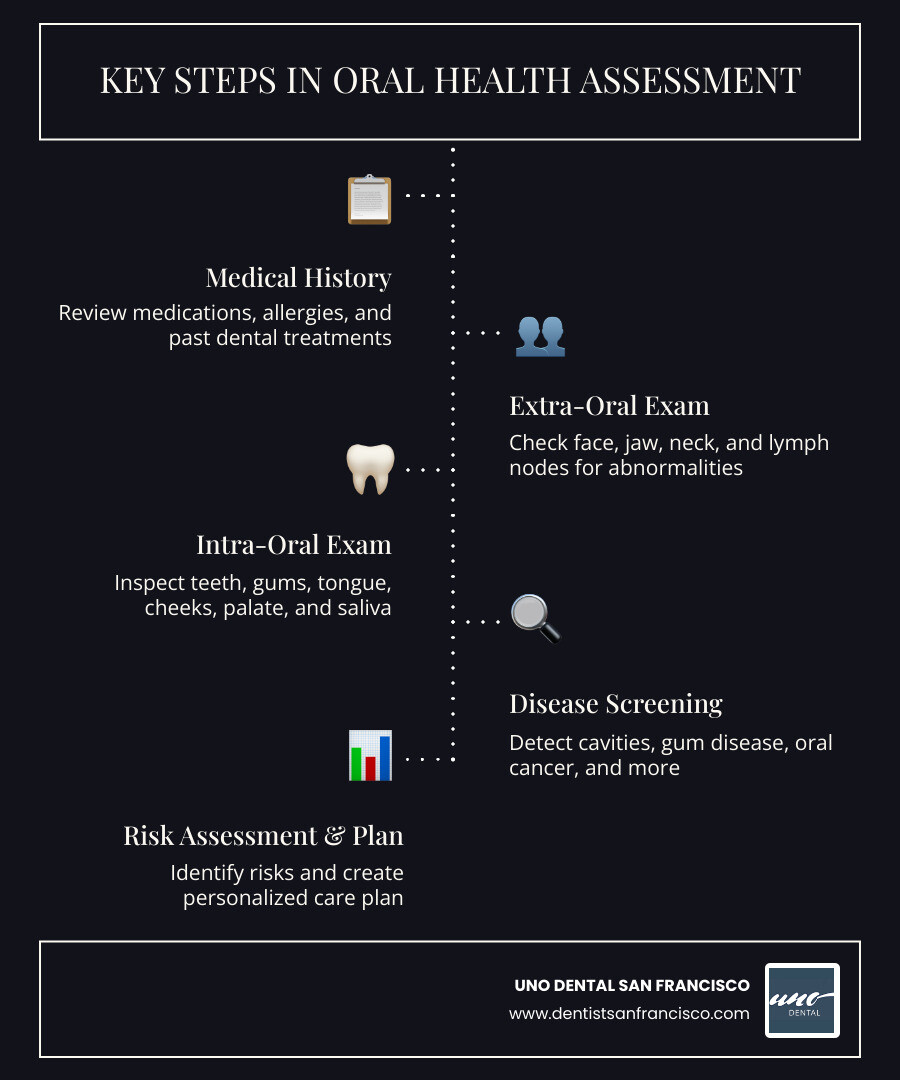
Here is what it typically covers:
- Medical and dental history — medications, allergies, past treatments
- Extra-oral exam — face, jaw, neck, and lymph nodes
- Intra-oral exam — teeth, gums, tongue, cheeks, palate, and saliva
- Disease screening — cavities, gum disease, oral cancer, and more
- Risk assessment — identifying factors that make you more vulnerable
- Personalized care plan — including how often you need to come back
The goal is not just to fix what is broken. It is to prevent problems before they start — and to spot early warning signs that are easy to miss without a trained eye.
Poor oral health is a leading cause of preventable hospital admissions in the United States, and the connection between oral health and overall systemic health is well established. What happens in your mouth does not stay in your mouth.
I'm Dr. Mohammad Aghiad Kandar, DDS, and with over 15 years of clinical experience — including advanced clinical training — I've conducted countless oral health assessments tailored to each patient's unique needs and risk profile. In this guide, I'll walk you through exactly what to expect during a comprehensive oral exam and why it matters for your long-term health.
To help you prepare for your visit, here are some basic terms related to your oral health assessment:
What is an Oral Health Assessment?
At its core, an oral health assessment is the first step in improving a person's oral and systemic well-being. Unlike a quick screening, it is a deep dive into the biological, behavioral, and environmental factors affecting your smile. It serves as a baseline to identify whether your mouth is "healthy," "changing," or "unhealthy," which then dictates the level of intervention required.
To ensure consistency across the globe, the World Health Organization (WHO) provides standardized guidelines for oral health surveys. These basic methods provide a sound basis for assessing the current status of a population and its future needs. By using standardized diagnostic criteria, we can compare data internationally and integrate oral health measurements into broader chronic disease surveillance systems. This is vital because oral diseases often share risk factors with other chronic conditions like diabetes and heart disease.
According to MedlinePlus Health Information, understanding tooth disorders is essential for maintaining overall health. When we perform an assessment, we aren't just looking for "holes" in teeth; we are evaluating the mouth as a complex organ system.

The Importance of Early Detection
Why do we emphasize these assessments so much? Because the cost of waiting is simply too high — both financially and physically. Failure to identify issues like Early Childhood Caries (ECC) can lead to severe pain, poor nutrition, and even developmental delays in children.
Consider these sobering statistics:
- In the United States, dental decay is the most common chronic disease of childhood, affecting thousands of children before they reach kindergarten.
- Gum disease affects nearly half of all adults over the age of 30.
- Poor oral health is a leading cause of preventable hospital admissions, often because minor issues were allowed to escalate into major infections.
By visiting us for regular evaluations, you ensure that we catch these issues when they are still reversible. For more on the benefits of prevention, see our guide on Why You Need to Visit the Dentist.
Standardized Tools for Oral Health Assessment
To keep our evaluations objective, we often look to validated tools used in various healthcare settings. One prominent example is the Oral Health Assessment Tool (OHAT). Originally designed for residential care settings (including patients with dementia), the OHAT is an eight-category screening tool that looks at:
- Lips: Checking for cracks, sores, or changes in color.
- Tongue: Looking for coatings, swelling, or lesions.
- Gums: Assessing for redness, swelling, or bleeding.
- Saliva: Checking for "dry mouth" (xerostomia) or thick, ropey saliva.
- Natural Teeth: Identifying broken, loose, or decayed teeth.
- Dentures: Ensuring they fit well and are clean.
- Oral Cleanliness: Measuring plaque and food debris.
- Dental Pain: Identifying signs of discomfort, even in non-verbal patients.
Scientific research on OHAT validity and reliability shows that it is a highly reliable tool. For instance, intra-carer agreement for dental pain is as high as 93.9%. While we use even more advanced clinical diagnostics at UNO DENTAL, these standardized categories form the backbone of a thorough screening.
The Procedure: Step-by-Step Examination Techniques
When you sit in our chair for a comprehensive oral exam, we follow a systematic process to ensure nothing is missed. We don't just "jump in" with the drill. We start with a conversation.
Preparation and Patient History
We begin by updating your medical and dental history. This includes:
- Medications: Many drugs cause dry mouth, which drastically increases your cavity risk.
- Allergies: We need to know about sensitivities to latex, metals, or local anesthetics.
- Social History: Habits like smoking or high sugar intake are major "modifying factors."
- Dental Anxiety: We want to make sure you feel comfortable and safe.
Extra-Oral Assessment
Before looking inside your mouth, we check the surrounding structures. We perform an extra-oral palpation of the head and neck to check for:
- Lymph Nodes: Swollen or tender nodes can indicate infection or, in some cases, malignancy.
- TMJ Assessment: We check your jaw joints for clicking, popping, or limited movement (normal opening is about 3 fingers wide, or 4-5 cm).
- Facial Asymmetry: Looking for swelling or masses that might suggest underlying issues.
For a deeper look at this process, check out our page on the Comprehensive Dental Checkup.

Conducting a Thorough Oral Health Assessment
Once we move inside the mouth, we use specific techniques to visualize every surface.
- 'Lifting the Lip': This is a simple but vital technique, especially for children. By lifting the upper lip, we can see the gum line where early decay (white spot lesions) often begins.
- Mucosal Inspection: We examine the cheeks (buccal mucosa), palate, and floor of the mouth. We look for things like linea alba (a white line from cheek biting) or leukoedema.
- Periodontal Screening (BPE): We use a specialized probe to measure the "pockets" between your teeth and gums. Healthy pockets are 1-3mm. Depths of 4mm or more indicate gum disease.
- ICDAS Staging: Instead of just saying you have a "cavity," we use the International Caries Detection and Assessment System (ICDAS) to stage decay from 1 (early enamel changes) to 6 (extensive cavitation).
- Dental Charting: We record the status of every tooth, including existing fillings, crowns, and missing teeth.
If this is your first time visiting us, our 1st Dentist Appointment Guide explains exactly how we integrate these steps into your initial visit.
Recognizing Signs and Symptoms of Disease
During the oral health assessment, we are trained to spot the "red flags" of various conditions:
- Dental Caries: We look for rough spots, dark holes, or chalky white lines.
- Gingivitis: Characterized by red, puffy gums that bleed when you brush or floss.
- Periodontal Disease: Signs include loose teeth, receding gums, and persistent bad breath (halitosis).
- Oral Cancer Screening: We look for ulcers that don't heal, red or white patches (erythroplakia or leukoplakia), and firm, fixed lumps.
- Systemic Indicators: Did you know that "meth mouth" (severe decay from methamphetamine use) or "Hutchinson incisors" (a sign of congenital syphilis) can be diagnosed through a dental exam? The mouth is truly a window to the body.
According to the Evaluation of the Dental Patient, a percussion test (gently tapping a tooth) can help us determine if an infection has reached the root or if you have a periapical abscess.
Risk Factors and Personalized Care Planning
At UNO DENTAL, we don't believe in "cookie-cutter" dentistry. Your oral health assessment leads directly to a personalized care plan. This plan is based on your specific risk factors and modifying factors.
Modifying Factors
These are the things that influence how likely you are to develop disease:
- Biological: Saliva flow, tooth anatomy, and genetics.
- Behavioral: Diet (frequency of sugar intake), brushing habits, and tobacco/alcohol use.
- Socio-economic: Access to care and fluoride exposure.
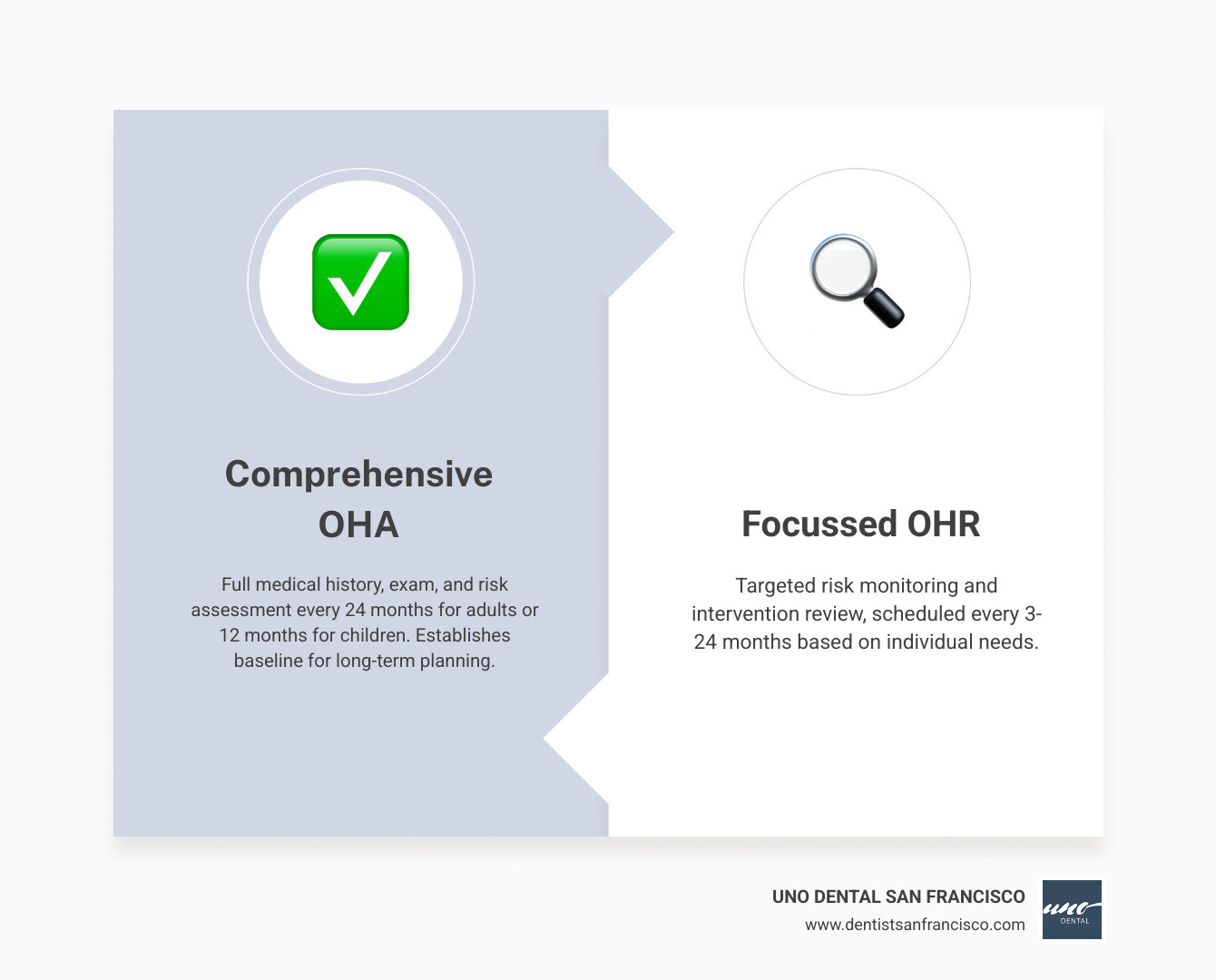
| Feature | Comprehensive OHA | Focussed Oral Health Review (FOHR) |
|---|---|---|
| Frequency | Every 24 months (Adults) / 12 months (Kids) | Risk-based (3 to 24 months) |
| Scope | Full history and status update | Targeted update on specific risks |
| Goal | Baseline and long-term planning | Monitoring and intervention |
| Documentation | Full dental charting and BPE | Progress notes and risk re-evaluation |
To understand how your oral health impacts your heart, brain, and beyond, read What Your Teeth Say About Your Overall Health.
Determining Recall Intervals
Gone are the days when everyone was told to come in every 6 months regardless of their health. Based on American Dental Association (ADA) recommendations and modern evidence, we set recall intervals based on your risk:
- Low Risk: May only need a comprehensive review every 12 to 24 months.
- High Risk: (e.g., active decay, heavy smokers, or diabetics) may need to see us every 3 months for a Focussed Oral Health Review.
Our goal is to give you the care you need, when you need it. Learn more in our Guide to Dental Health San Francisco.
Preventive Advice and Education
The most important part of the assessment is what happens after the exam. We provide you with the tools to take charge of your health at home:
- Fluoride: We recommend the right concentration of fluoride toothpaste based on your age and risk.
- Technique: We don't just tell you to brush; we show you how to reach the tricky spots.
- Nutrition: We discuss how "hidden sugars" and acidic drinks (like soda or over-chlorinated pool water) can erode your enamel.
For a sneak peek at what this education looks like, see Smile Bright: What Happens at Your First Dentist Appointment.
Specialized Assessments for Different Populations
We recognize that a toddler, a pregnant mother, and a senior citizen all have very different needs.
Pediatric Oral Health
Early Childhood Caries (ECC) is a significant concern. We recommend a child's first oral health assessment by age one or when the first tooth erupts. Children with special health care needs are at a 3x higher risk for poor oral health, making early intervention even more critical.

Assessments in Residential and Aged Care
As we age, our oral health needs become more complex. Frail older adults, particularly those with dementia or functional dependence, are at high risk. Factors like polypharmacy (taking multiple medications) often lead to severe dry mouth, while cognitive decline can make daily brushing difficult. For these patients, we use tools like the Oral Health Assessment Tool (OHAT) to monitor health and prevent pain.
Managing Referrals and Emergency Care
The outcome of an assessment usually falls into one of three categories:
- Healthy: Maintain with routine home care and scheduled reviews.
- Early Decay/Gingivitis: Managed with preventive treatments like fluoride varnish or professional cleanings.
- Advanced Disease: Requires a referral for restorative work, root canals, or extractions.
In cases of dental emergencies — like severe pain or trauma — an immediate assessment is required to prevent permanent tooth loss. You can find more details in The Full Scoop: What Happens During Your Comprehensive Oral Exam.
Frequently Asked Questions about Oral Health Assessments
How does an oral health assessment differ from a standard check-up?
A "check-up" is often perceived as just looking for cavities. An oral health assessment is a comprehensive, risk-based evaluation. It integrates your medical history and lifestyle to create a personalized care plan. It’s the difference between "fixing a hole" and "understanding why the hole formed so we can prevent the next one." See more at Dental Checkup San Francisco.
What are the reliability statistics for assessment tools like OHAT?
Studies show that OHAT is highly reliable, even when used by non-dental professionals like nurses or caregivers.
- Intra-carer reliability: Percent agreement ranges from 74.4% (cleanliness) to 93.9% (pain).
- Inter-carer reliability: Percent agreement ranges from 72.6% to 92.6%.
- Kappa statistics: Show moderate to substantial agreement (0.51-0.80), proving it’s a stable way to track health over time.
Can non-dental professionals perform a basic oral health assessment?
Yes! In fact, we encourage it. Community health nurses, teachers, and caregivers can use the ASK-LOOK-DECIDE framework to screen for issues. While they cannot provide a clinical diagnosis, they can identify when a professional referral is needed. This is common in school entry health checks and aged care facilities.
Conclusion
At UNO DENTAL San Francisco, we believe that a healthy smile is the foundation of a healthy life. Our oral health assessment process is designed to be high-tech, holistic, and entirely centered on you. By combining advanced diagnostics with a warm, patient-first approach, we help you navigate your dental journey with clarity and confidence.
Whether you're looking for a routine review or have a specific concern, we're here to help. We also offer free virtual smile consultations so you can explore your options from the comfort of home. If you're searching for a comprehensive oral health assessment in San Francisco, contact UNO DENTAL San Francisco today to schedule your appointment. Experience our individualized treatments and expert care, all under one roof, and take the first step toward long-term oral and overall health.